
Controversy Erupts as FIFA Lifts Ban from Balogun
FIFA has suspended the implementation of United States striker Folarin Balogun’s one-match ban, making him eligible for the FIFA World Cup Round of 16 against Belgium. The decision has immediately become one of the tournament’s biggest talking points because a direct red card normally carries an automatic one-match suspension under FIFA competition regulations. Balogun was dismissed after a VAR review during the United States’ 2-0 Round of 32 victory over Bosnia and Herzegovina, where his challenge on defender Tarik Muharemović was judged to be serious foul play. Instead of enforcing the suspension immediately, FIFA announced that it would apply Article 27 of its Disciplinary Code and place the sanction under a one-year probationary period.
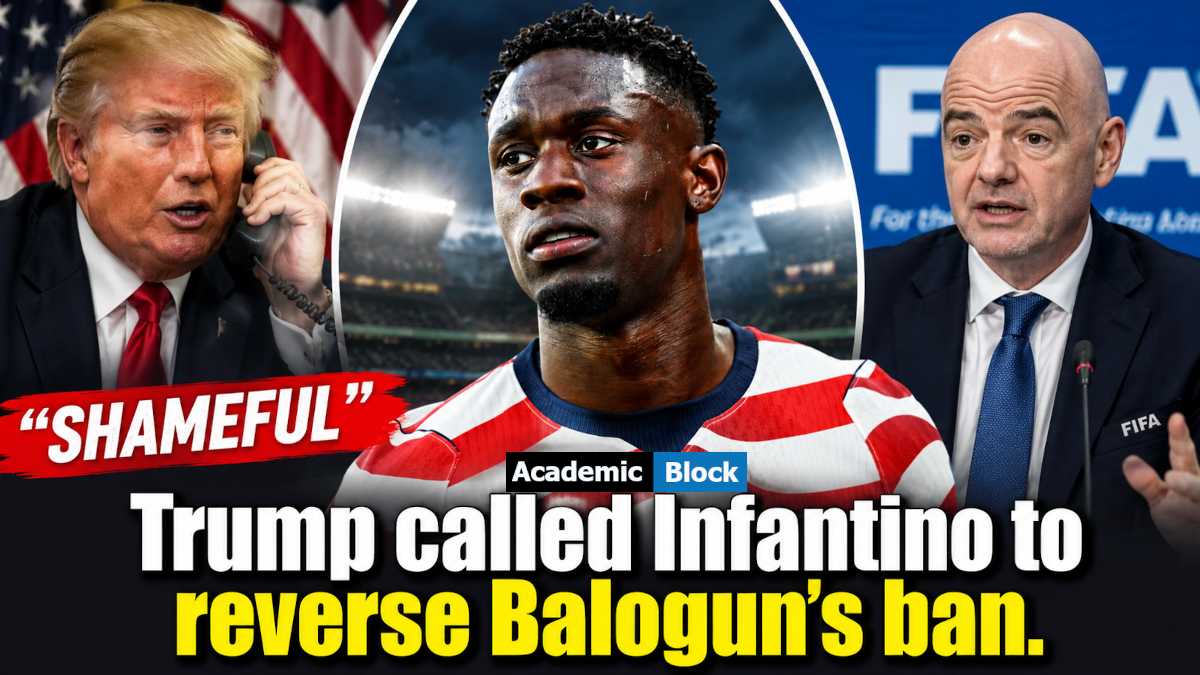
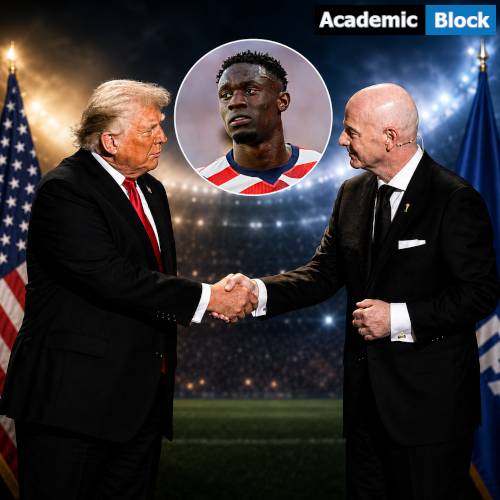
Reports claimed that President Donald Trump spoke directly with FIFA President Gianni Infantino and requested a review of Folarin Balogun’s suspension. In addition, White House World Cup Task Force Executive Director Andrew Giuliani and Commerce Secretary Howard Lutnick were also reported to have contacted FIFA over the matter. As preparations continue, the discussion has expanded beyond one player to broader questions about FIFA’s disciplinary consistency and the precedent this decision could set.
FIFA Invokes Article 27 to Suspend Balogun’s Ban Ahead of Round of 16
FIFA said its decision was based on Article 27 of the FIFA Disciplinary Code, a provision that allows a judicial body to suspend the implementation of a disciplinary sanction under specific circumstances. Under the ruling, Folarin Balogun’s one-match suspension will remain inactive during a one-year probationary period. FIFA also stated that the original sanction could still be enforced if the United States striker commits a similar offence during that period. However, the governing body did not explain why Article 27 was applied in this particular case. That omission has raised important legal and procedural questions about the interpretation of FIFA’s disciplinary rules during the World Cup.
The decision has attracted global attention because it appears to be unprecedented in the modern World Cup era. It also appears to be the first instance since 1962 in which a World Cup red card has not resulted in an immediate suspension. In 1962, Brazil’s Garrincha played in the World Cup final after his semifinal dismissal because automatic suspensions were not yet part of the tournament regulations. Reports have also claimed that U.S. President Donald Trump contacted FIFA President Gianni Infantino after the incident and requested a review of Balogun’s suspension. While FIFA has identified Article 27 as the legal basis for its ruling, it has provided no further justification. As a result, the decision has intensified debate over transparency, consistency, and the future application of FIFA’s disciplinary framework in the world’s biggest football tournament.
Mauricio Pochettino Welcomes FIFA’s Decision Ahead of Belgium Clash
United States head coach Mauricio Pochettino defended FIFA’s decision and argued that his team had already paid a heavy sporting price after Balogun’s dismissal. He said the United States competed for around 35 minutes with ten players against Bosnia and Herzegovina, making it difficult to suggest the team had received any unfair advantage. Pochettino described the outcome as a matter of fairness rather than preferential treatment. When asked about reports of political involvement, he said football and politics should not be mixed. He also responded respectfully to Belgium coach Rudi Garcia, saying Garcia had every right to defend his team but that words such as “integrity” and “ethics” should not be judged through a single incident.
Reactions elsewhere remained sharply divided. Belgium’s Royal Belgian Football Association continued to question FIFA’s decision, while several coaches and analysts warned that the ruling could influence future disciplinary cases. Inside the United States camp, defender Chris Richards said the players initially thought the news circulating on social media was generated by artificial intelligence before FIFA confirmed Balogun’s availability. Captain Christian Pulisic added that Belgium would now have to prepare for another attacking option, while emphasizing that team selection often changes before major matches. With the controversy still dominating headlines, the focus now turns to whether Balogun’s return will shape the outcome on the pitch or whether the debate surrounding FIFA’s decision will continue long after the final whistle.
Web Resources on FIFA Lifts Ban from Balogun
1. BBC.com : Red card system in disarray over Trump, Fifa and Balogun decision
2. Guardian.com : Mauricio Pochettino praises Fifa for Balogun U-turn, ‘We celebrate the decision’.
3. AP News.com : FIFA lifts US star striker Balogun’s red card suspension at World Cup after Trump calls Infantino