
Meloni Proposes Burqa and Niqab Ban, Limits on Foreign Students in Italian Schools
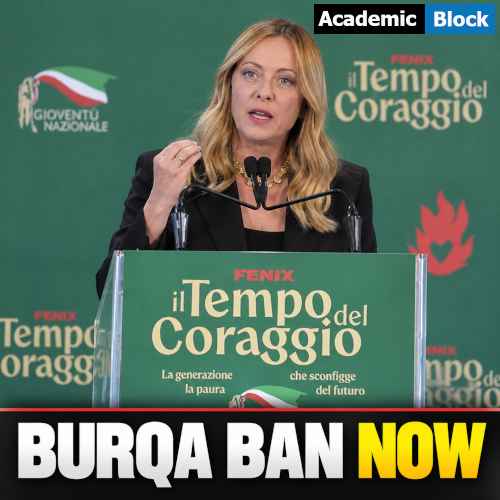
Italy is preparing new school rules on face coverings and the number of foreign students in each classroom. Prime Minister Giorgia Meloni announced the proposals on Sunday at a youth event organised by her Brothers of Italy party. The plan would ban burqas and niqabs in Italian schools, while the government would also introduce a legal limit on foreign students in each class. However, officials have not yet announced the exact limit. The proposal also includes an Italian-language requirement for some parents of foreign students who face serious integration difficulties.
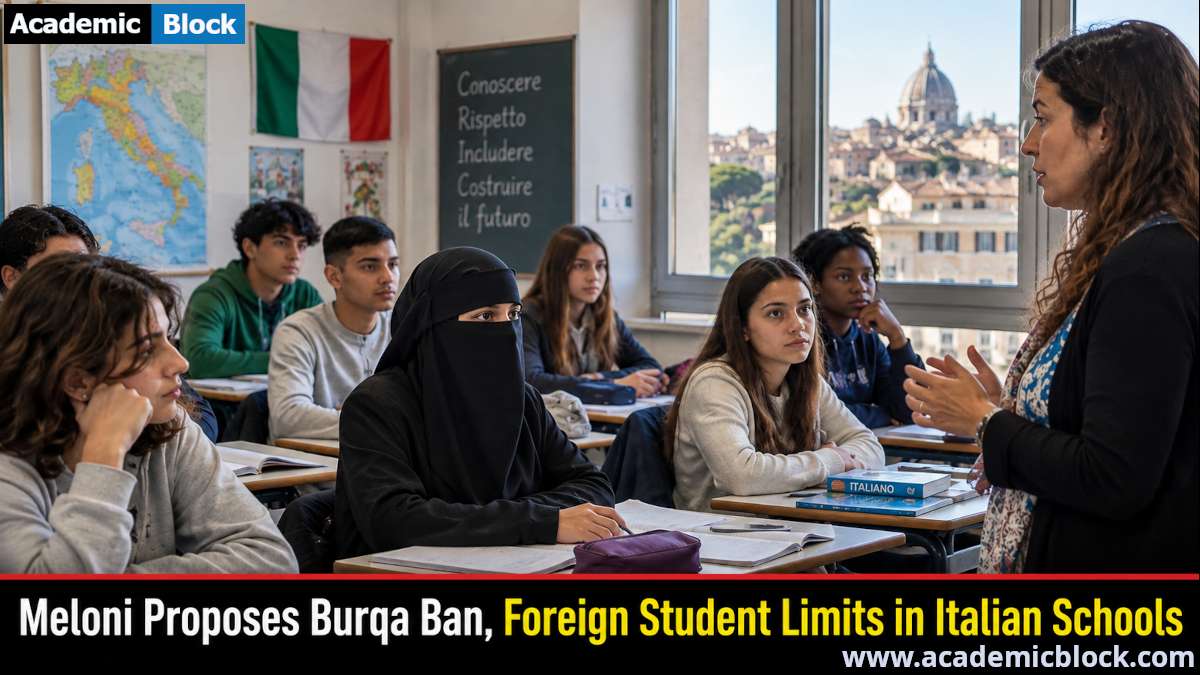
Meloni said a common language is essential for students to learn and integrate at school. She argued that teachers and classmates can support a child who struggles with Italian. However, she said the challenges can become greater when students with limited Italian skills make up a large share of a class. The proposals therefore combine rules on religious face coverings, foreign student numbers and language support, as the government seeks to address integration and education challenges in Italian schools.
Meloni’s Plan Targets Full-Face Veils and Classroom Quotas in Italian Schools
Italy’s proposed school law would ban the burqa and niqab, while leaving the hijab unaffected. A burqa covers the body and includes a mesh screen over the eyes, while a niqab covers the face but leaves the eyes visible. Education Minister Giuseppe Valditara first proposed a veil ban in August as part of a wider security bill. Prime Minister Giorgia Meloni has said students should attend school with their faces uncovered and argued that tradition should not require a young woman to hide her face. If approved, Italy would join several European countries with restrictions on full-face coverings. France and Belgium introduced nationwide bans in 2011, while Austria, Denmark, the Netherlands and Switzerland have adopted different restrictions. Portugal completed similar legislation in August 2026. Germany, however, has no nationwide ban and mainly restricts face coverings for public workers.
The bill would also create a legal limit on foreign pupils in each classroom. Italy already has a 30% guideline from a 2010 ministerial circular, but local conditions have often made the rule difficult to enforce. In Italy, critics have raised constitutional concerns, with law professor Salvatore Curreri citing Article 34, which guarantees education for everyone. Opposition lawmaker Angelo Bonelli has also criticised the proposal as a distraction from low teacher pay. The package will now go to the Cabinet and must clear Parliament before it can become law.
Why Meloni Proposed a School Ban on Burqas and Limits on Foreign Students
Italian Prime Minister Giorgia Meloni has given several reasons for the proposed ban on burqas and niqabs in schools and limits on foreign students per class. She wants Italian children to feel comfortable in their own classrooms and aims to promote what her government describes as genuine integration. Meloni also insists that students should attend school with their faces uncovered, arguing that full-face coverings conflict with transparency and equality.
Meanwhile, migration remains a sensitive political issue in Italy, while the next national election is due in 2027. Meloni also faces pressure from parts of the right, including retired general and politician Roberto Vannacci, who has called for tougher policies on migration and national identity. Vannacci’s position adds another dimension to the debate around Meloni’s school proposals. However, the opposition argues that the measures are also politically aimed at attracting right-wing voters. Meloni presents the proposals as practical steps to improve language learning, integration and classroom balance.
Italy’s Muslim Population Fuels Integration Debate
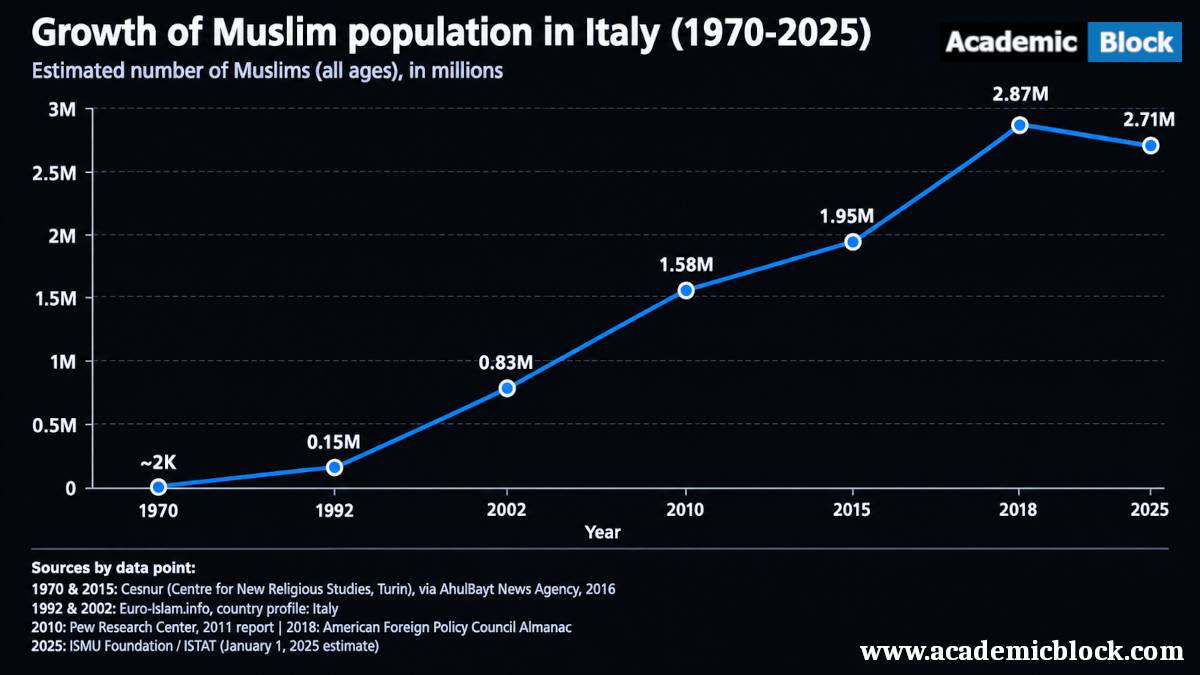
The rapid growth of the Muslim population in Italy from nearly zero in 1950 to an estimated 2.3–2.7 million people (around 4–4.9% of the population) by 2026 has become a major political and social issue because it has raised serious concerns about cultural integration, social cohesion, and the changing character of Italian society. Many Italians, including political leaders like Giorgia Meloni, argue that the sharp increase driven by immigration has created challenges in schools, neighborhoods, and public spaces, particularly when large numbers of non-Italian speaking students concentrate in classrooms or when cultural practices such as full-face veils conflict with Italian norms of visibility and equality.
Web Resources On Meloni Proposes Burqa and Niqab Ban
1. Reuters : Italy to ban veils in schools, limit foreign students per class, Meloni says.
2. AP News : Meloni plans to ban burqas and niqabs in Italian schools, and cap foreign students in classrooms.
3. ABC News : Meloni plans to ban burqas and niqabs in Italian schools, and cap foreign students in classrooms.
4. Euro News : Meloni announces ban on burqa and niqab in Italian schools, cap on foreign students.