
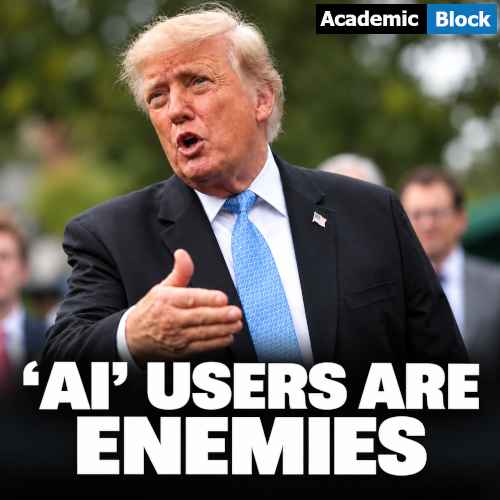
Trump Calls Those Using ‘AI’ ‘The Enemy’ in Push for ‘Super Intelligence’
U.S. President Donald Trump has intensified his campaign to rename artificial intelligence as “Super Intelligence,” warning that people who use “AI” instead of “SI” are “the enemy.” He made the remark in a Truth Social post on Thursday, October 8. His comments reflect an effort to establish “Super Intelligence” as the preferred term for the rapidly advancing technology.

Elon Musk and Amazon Executive Chairman Jeff Bezos have also drawn attention to the debate. Musk said on October 4 that his company, SpaceXAI, would change its name to SpaceXSI. Bezos, meanwhile, expressed a preference for “SI” during an interview, arguing that the word “artificial” could suggest something fake to some people. Their comments have added momentum to the discussion, but they do not indicate that all technology companies support Trump’s proposal or have adopted the new terminology.
AI vs. Super Intelligence: What Is the Difference?
Artificial intelligence is a broad field of technology that enables computer systems to perform tasks associated with human intelligence. These tasks include answering questions, translating languages, analyzing data, recognizing images and generating content. Examples include ChatGPT, AI image generators and voice assistants. AI already supports work in science, medicine, business and everyday life. However, its capabilities vary widely. Some systems outperform humans at specific tasks, while others struggle with tasks that people perform easily.
Superintelligence, by contrast, refers to a hypothetical form of intelligence that could surpass human abilities across almost every intellectual field. Such a system could potentially solve complex problems, make scientific discoveries and develop technologies beyond the reach of even the most skilled human experts. However, no existing system has demonstrated this level of intelligence across all these fields. The distinction also matters for debates over AI safety, privacy, cybersecurity, employment and government regulation. Although Trump argues that “Super Intelligence” better describes modern AI, changing the terminology does not prove that current systems have achieved superintelligence. AI is an established technology, while superintelligence remains a theoretical possibility.
Trump’s Executive Order Directs Federal Agencies to Adopt ‘Super Intelligence’
President Donald Trump signed an executive order titled “Inaugurating the Era of Super Intelligence” on September 29, 2026. It directs federal departments and agencies to use “Super Intelligence” and “SI” instead of “Artificial Intelligence” and “AI” in most official communications. The policy covers government correspondence, websites, reports and policy documents. However, agencies do not need to revise existing regulations, presidential actions, contracts, grants or historical records. The order also does not require private companies to adopt the new terminology.
The order uses the existing federal legal definition of artificial intelligence to define “Super Intelligence.” It also gives the president’s science and technology adviser 60 days to propose legislative language for a federal definition and consider updates to existing laws. However, the directive does not establish a new technical definition or prove that current AI systems have achieved superintelligence. It also raises questions about whether governments should determine technology terminology or leave that task to the scientific community. Changing the name may reshape official language, but it will not resolve the technical, legal and social challenges surrounding AI.
Web Resources On Trump Calls AI Users ‘The Enemy’
1. Politico : Trump says anyone who does not refer to AI as ‘super intelligence’ is ‘THE ENEMY’.
2. Forbes : Trump Calls Anyone Who Says ‘AI’ Instead Of ‘Super Intelligence’ An ‘Enemy’.
3. France24 : Trump’s ‘super intelligence’ rebrand to sell AI faces uphill battle.
4. Axios : Trump: Anyone saying “AI” is “THE ENEMY!” The White House uses it.