Morphic Resonance: Morphic Field and Rupert Sheldrake

Morphic Resonance: Fields of Collective Memory

Morphic Resonance is a hypothesis proposed by Rupert Sheldrake, suggesting that natural systems inherit a collective memory from all previous similar systems. This concept posits that patterns of behavior and structure are transmitted through a non-local field, influencing development and evolution.
A silhouette of a head surrounded by interconnected smaller figures, linked by dynamic wavy lines, seamlessly illustrating morphic resonance and the collective memory field.

Overview

Morphic resonance is a fascinating and controversial theory proposed by biologist Rupert Sheldrake. It suggests that nature has a kind of collective memory that influences the behavior and development of organisms. According to this idea, once something is learned by one group, it becomes easier for others to learn it—even if they are far away and have no direct connection. This theory challenges conventional science, which relies on genes and environmental factors to explain inheritance and evolution. In this article by Academic Block, we will explore morphic resonance in depth, its implications, criticisms, and potential applications in fields like biology, psychology, and even human consciousness.
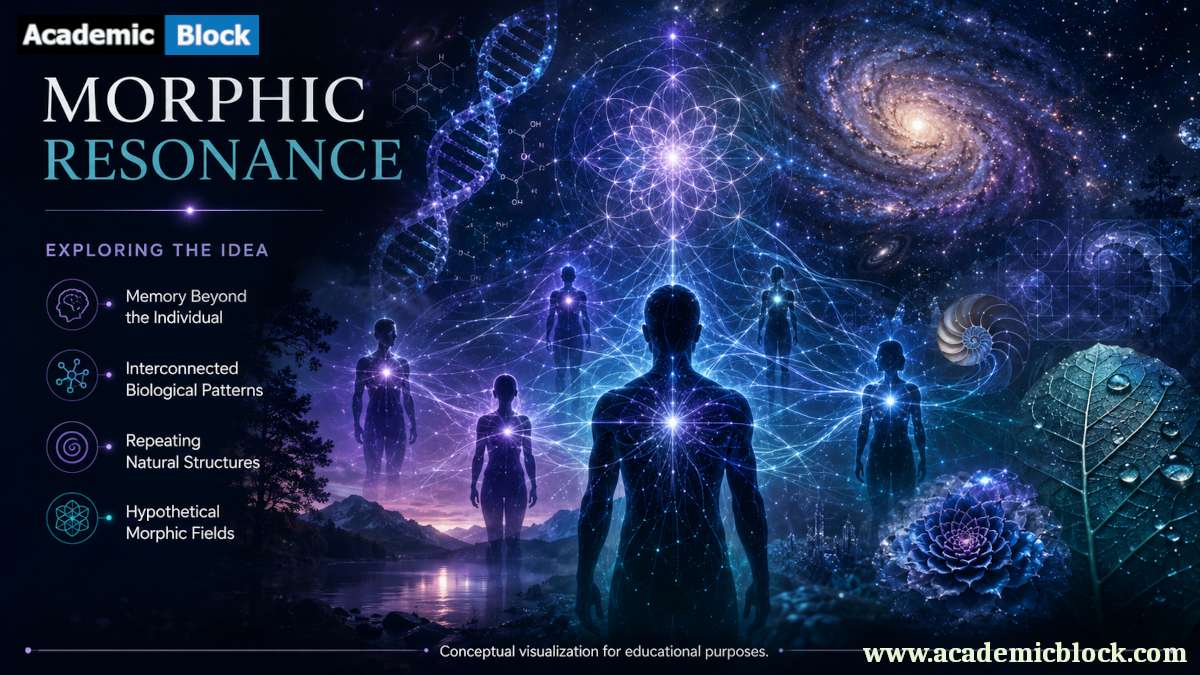
What is Morphic Resonance?

Morphic resonance is based on the idea that natural systems, including plants, animals, and even human cultures, share a collective memory. This memory is not stored in genes or the brain but exists in invisible energy fields called morphic fields. These fields influence how organisms grow, behave, and evolve over time.

Sheldrake suggests that these morphic fields carry information, just like radio waves carry music. The more a behavior or pattern is repeated, the stronger the field becomes, making it easier for others to adopt the same pattern.

Key Concepts of Morphic Resonance

Key Concepts
Description
Morphic Fields
- These are invisible energy fields that shape the development and behavior of living things.
- They act as a blueprint, guiding growth and organization in plants, animals, and even social groups.
Collective Memory
- Once a new skill or behavior is learned, it becomes part of the collective memory of a species.
- Future generations can access this memory and learn faster than before.
Non-Local Influence
- Unlike genetic inheritance, which is passed down through DNA, morphic resonance allows knowledge to spread instantly without physical contact.
- This means that if rats learn a new trick in one part of the world, rats in another region might learn it faster.

This infographic image shows the scientific background of morphic resonance, covering morphogenetic fields, the 100th monkey effect, crystal experiments, and rat learning studies.

Scientific Background and Examples of Morphic Resonance

Although morphic resonance is not widely accepted by mainstream science, Sheldrake and others have conducted experiments to support the theory. Some notable examples include:

  1. The Hundredth Monkey Effect : One of the most famous stories related to morphic resonance is the Hundredth Monkey Effect. In the 1950s, Japanese scientists observed that monkeys on an island learned to wash sweet potatoes before eating them. After a certain number of monkeys (hypothetically the "hundredth") adopted this habit, monkeys on nearby islands, who had never seen the behavior, also started washing their potatoes.

  2. The Rat Maze Experiments : Sheldrake cited experiments where rats in laboratories were taught to navigate mazes. Over time, rats in distant labs learned to solve the same mazes more quickly—even though they had never been exposed to the original group.

  3. Learning in Humans : Some psychologists believe morphic resonance could explain how human knowledge and behaviors evolve over generations. For example:-

    • Once a mathematical problem is solved for the first time, students around the world might find it easier to solve.
    • Certain artistic or technological innovations seem to emerge in different places simultaneously.

Morphic Fields: Definition and Features

Morphic fields are central to Rupert Sheldrake’s theory of morphic resonance, describing invisible energy structures that shape the behavior, development, and learning processes of living organisms. These fields act as blueprints, influencing biological evolution, collective memory, and social patterns.

Feature
Description
Definition
Morphic fields are non-material energy fields that store patterns of behavior, influencing the growth and learning of species over time.
Collective Memory
Once a species learns a new skill, it is stored in the morphic field, making it easier for future generations to learn.
Non-Local Influence
Knowledge and behaviors can spread instantly across distances, bypassing traditional genetic inheritance.
Self-Organizing Systems
These fields guide natural development, helping maintain order and stability in biological and social structures.
Influence on Consciousness
Some researchers suggest morphic fields could explain intuition, creativity, and telepathy.
Connection to Evolution
Unlike Darwinian evolution, morphic resonance suggests learning can shape species' development beyond DNA.

Morphic fields remain a debated concept but provide a unique perspective on collective learning, biological organization, and social evolution.

This informative image shows supporting evidence for morphic resonance, including rat learning experiments, easier crossword puzzles after prior solutions, crystal formation of similar structures, and animal mimicry of non-native species.

Supporting Evidence for Morphic Resonance

Morphic resonance, though controversial, has been linked to various phenomena across biology, psychology, and sociology. Proponents, including Rupert Sheldrake, suggest supporting evidence from several fields:

  1. Animal Behavior and Learning : Studies on rats solving mazes suggest that once a skill is learned, future generations acquire it faster, even without direct exposure. This challenges genetic inheritance and supports the idea of a shared morphic field.

  2. Collective Human Memory : The sudden emergence of new ideas, artistic trends, or scientific breakthroughs may be influenced by morphic resonance, allowing knowledge to spread across human consciousness.

  3. Cultural and Social Patterns : The rapid spread of innovations or behaviors across societies, despite no direct contact, may result from a non-local morphic field.

  4. Telepathy and ESP : Sheldrake proposes that extrasensory perception (ESP) and telepathy occur through morphic fields, enabling thoughts and experiences to resonate across individuals instantly.

These insights suggest that morphic resonance could reshape our understanding of learning, memory, and interconnectedness.

Potential Applications of Morphic Resonance

If true, morphic resonance could have significant implications in many fields, including:

Applications of Morphic Resonance
Description
Education and Learning
- Schools could benefit from previous generations' collective knowledge, making learning faster and easier.
- New languages, skills, and problem-solving techniques might spread more efficiently across cultures.
Healing and Medicine
- Alternative healing methods like energy medicine, acupuncture, and homeopathy could be explained by morphic fields.
- The body's ability to heal itself might be influenced by the collective health patterns of others.
Evolution and Biology
- Evolution may not rely only on genetic mutation and natural selection but also on learned behaviors passed through morphic fields.
- Species might adapt faster than expected because of inherited knowledge from previous generations.
Artificial Intelligence and Technology
- AI and machine learning might develop faster if algorithms can "learn" from previous models without direct programming.
- Digital consciousness or group intelligence might emerge based on accumulated data.

This image highlights scientific skepticism on morphic resonance, citing lack of empirical evidence, an unexplained mechanism, incompatibility with established science, and failure to replicate results.

Criticism and Scientific Skepticism on Morphic Resonance

Despite its intriguing nature, morphic resonance has faced significant criticism from mainstream scientists. Some key objections include:

(i) Lack of Empirical Evidence

  • Most experiments supporting morphic resonance are anecdotal or have not been reliably reproduced.
  • Many of Sheldrake’s studies have been criticized for lacking proper scientific controls.

(ii) Contradiction with Established Science

  • Modern biology attributes learning and inheritance to genes, neural networks, and environmental factors.
  • Quantum physics and neuroscience do not recognize morphic fields as a known force.

(iii) Statistical Errors and Bias

  • Skeptics argue that the experiments showing morphic resonance can be explained by chance, psychological bias, or flawed methodology.
  • Many of Sheldrake’s claims are considered speculative rather than scientifically validated.

(iv) Lack of a Clear Mechanism

  • Science requires a clear mechanism to explain how morphic resonance works.
  • Unlike DNA, which carries genetic instructions, morphic fields remain undefined in physical terms.

What was Rupert Sheldrake’s Response to Critics on the Morphic Resonance Theory?

Rupert Sheldrake acknowledges these criticisms but argues that:

  1. Scientific paradigms change over time, and morphic resonance might be a future breakthrough.
  2. Many scientific discoveries, such as quantum mechanics, were initially dismissed before being accepted.
  3. More research is needed to explore unexplained phenomena that do not fit within traditional models.

Comparison of Morphic Resonance with Other Theories

Morphic resonance shares similarities with several other concepts in science and spirituality:

Theory
Similarity to Morphic Resonance
Key Difference
Collective Unconscious (Carl Jung)
Suggests shared human memory
More psychological than biological
Quantum Entanglement
Non-local connections exist in nature
Applies only to subatomic particles
Akashic Records (Spiritual Tradition)
Information is stored in a universal field
More metaphysical than scientific
Epigenetics
Environment influences future generations
Involves DNA changes rather than energy fields

These comparisons show that while morphic resonance is not widely accepted in science, similar ideas exist in psychology, physics, and spirituality.

Future Research and Possibilities on Morphic Resonance

Although mainstream science remains skeptical, some researchers believe morphic resonance deserves further study. Future research could involve:
  1. Controlled experiments on learning behaviors across generations.
  2. Studying how cultural trends emerge without direct influence.
  3. Exploring whether AI and machine learning exhibit non-local learning.
  4. Investigating links between morphic fields and consciousness.

If morphic resonance is proven, it could revolutionize our understanding of inheritance, learning, and evolution.

Final Words

Morphic resonance is a thought-provoking theory that suggests living beings share a collective memory that influences learning and evolution. While it challenges traditional science, it offers intriguing explanations for unexplained phenomena. Although criticized for its lack of empirical evidence, morphic resonance continues to spark debate in scientific and spiritual communities. Whether or not it is eventually accepted, the theory raises important questions about how knowledge, habits, and biological traits are passed through generations. Please provide your views in the comment section to make this article better. Thanks for Reading!

Questions and answers related to Morphic Resonance:

+ Morphic Resonance Meaning >

Morphic resonance is a concept suggesting that natural patterns and behaviors are influenced by collective memory across time. It proposes that forms, habits, and species evolution are shaped by previous occurrences, potentially linking biology, culture, and consciousness, and offering a new perspective beyond traditional scientific models.

+ What is morphic resonance theory? >

Morphic resonance theory, proposed by Rupert Sheldrake, suggests that systems inherit collective memory from similar past systems. It implies that physical forms, behaviors, and social habits are influenced by prior patterns, potentially bridging biology, psychology, and sociology with a fresh lens for understanding evolution and cultural development.

+ What is a morphic field in humans? >

A morphic field in humans is a hypothesized energy pattern that guides physical, mental, and behavioral traits. It suggests that habits, skills, and social behaviors may be influenced by cumulative human experience, shaping individual development and potentially contributing to collective intelligence and evolution.

+ Do morphic fields really work? >

The efficacy of morphic fields remains speculative. While anecdotal reports suggest patterns of learning or evolution influenced by collective memory, mainstream science lacks conclusive empirical evidence. Researchers continue to explore its potential implications in biology, consciousness studies, and behavioral sciences as an intriguing but unproven concept.

+ How to use morphic fields in humans? >

To utilize morphic fields in humans, practitioners often suggest meditation, visualization, and repetition of positive habits. The approach aims to strengthen personal development by aligning with collective behavioral patterns. While practical applications are largely experimental, these methods seek to optimize learning, wellness, and skill acquisition naturally.

+ Is there any evidence for morphic resonance? >

Evidence for morphic resonance is largely theoretical and anecdotal. Some experiments suggest patterns in learning or species development may align with previous occurrences, but mainstream science considers it unproven. Ongoing research investigates its potential role in biology, memory, and consciousness to establish credible empirical support.

+ What are some examples of morphic resonance? >

Examples of morphic resonance include the rapid learning of new behaviors in animals, spontaneous problem-solving, or cultural patterns spreading faster than expected. Sheldrake proposed that once a pattern occurs in one system, similar systems are more likely to replicate it, indicating potential collective memory effects.

+ Does morphic resonance challenge Darwinian evolution? >

Morphic resonance offers an alternative perspective to Darwinian evolution by suggesting that inherited patterns may influence species development. While it does not fully replace natural selection, it proposes that memory effects in nature could complement traditional evolutionary mechanisms, sparking debates in evolutionary biology and philosophy of science.

+ What are the criticisms of morphic resonance? >

Morphic resonance faces criticism for lacking empirical evidence and testable predictions. Many scientists argue it contradicts established biology and evolution principles. While intriguing, it remains a controversial hypothesis, sparking debates in scientific communities about its validity and applicability in both biology and consciousness studies.

+ Can morphic resonance explain paranormal phenomena? >

Some theorists suggest morphic resonance could provide a framework for paranormal phenomena, including telepathy or precognition, by positing collective memory fields. However, mainstream science considers this speculative, and rigorous studies are lacking, making its connection to paranormal events more theoretical than empirically validated.

+ What is the history of Rupert Sheldrake morphic resonance? >

Rupert Sheldrake introduced morphic resonance in the 1980s through his book "A New Science of Life." He proposed that natural patterns are influenced by collective memory across time. The theory challenged conventional science and sparked debates in biology, consciousness studies, and alternative scientific theories worldwide.

+ What are some examples of morphic resonance in humans? >

Examples include rapid skill acquisition, shared behavioral patterns, or spontaneous problem-solving. Sheldrake proposed that once a human pattern occurs, others can learn or replicate it faster, implying collective memory influences. These examples remain largely anecdotal but highlight potential applications in learning and personal development.

+ Who was Rupert Sheldrake, man behind morphic resonance? >

Rupert Sheldrake is a British biologist and author known for proposing morphic resonance. Educated at Cambridge and Harvard, he challenged traditional biology by introducing concepts linking collective memory, evolution, and consciousness. His work remains influential in alternative science and debates on the nature of life and patterns.

+ Can morphic resonance be applied to human consciousness? >

Morphic resonance may be applied to human consciousness by suggesting that thoughts, habits, and learning are influenced by cumulative experiences. Though speculative, it hints at shared mental patterns across individuals, potentially contributing to personal development, collective intelligence, and the transmission of cultural or behavioral norms.

+ How does morphic resonance relate to other fringe sciences or alternative theories? >

Morphic resonance intersects with fringe sciences like parapsychology, energy healing, and consciousness studies. It complements theories of collective memory, telepathy, or subtle energy fields, offering alternative perspectives on evolution, learning, and human potential. Mainstream science remains skeptical but acknowledges its conceptual influence on alternative thought.

+ What is the summary of Morphic Resonance: The Nature of Formative Causation? >

Sheldrake's "Morphic Resonance: The Nature of Formative Causation" argues that natural forms and behaviors are shaped by cumulative patterns from the past. It challenges strict mechanistic biology and proposes that collective memory influences evolution, behavior, and learning, offering a paradigm-shifting perspective on the interconnectedness of life.

Major Conspiracy theories revolving around Morphic Resonance

Government Suppression of Morphic Resonance Research: In this speculative scenario, conspiracy theorists might suggest that governments are actively suppressing research on morphic resonance due to its potential societal implications. These theorists could claim that the acknowledgment of morphic fields and resonance might lead to a paradigm shift challenging existing power structures or control mechanisms. Allegations might include the notion that government agencies are discreetly influencing scientific funding and publications to downplay or dismiss research on morphic resonance.

Corporate Sabotage of Morphic Resonance Technology: In a more futuristic conspiracy theory, enthusiasts might propose that corporations with vested interests in traditional technologies are actively sabotaging the development and application of morphic resonance technology. The idea could be that such technologies, if successfully developed, could revolutionize various industries, potentially rendering existing technologies obsolete. Allegations might include claims of corporate espionage, manipulation of research outcomes, or stifling innovation through legal and financial means.

Suppression of Morphic Resonance by Scientific Establishment: In this hypothetical scenario, conspiracy theorists might suggest that the scientific establishment is deliberately suppressing research on morphic resonance. They could claim that mainstream scientists, influenced by certain ideologies or interests, aim to prevent the widespread acceptance of this theory. Such allegations might be fueled by the idea that morphic resonance challenges established scientific norms, and a conspiracy is allegedly underway to maintain the status quo.

Commercial Interests Hindering Morphic Resonance Acceptance: Another hypothetical conspiracy theory might revolve around the idea that powerful commercial interests, such as pharmaceutical or biotechnology companies, are working to suppress research on morphic resonance. Proponents of this theory might argue that the acceptance of morphic resonance could disrupt existing industries heavily invested in genetic and materialistic approaches to biology. Allegations could include claims that these industries are influencing scientific discourse and funding to maintain their dominant positions.

Facts on Morphic Resonance

Memory in Nature: One of the central tenets of morphic resonance is the idea that nature has a form of memory. According to Sheldrake, this memory is not stored in physical structures like brains or genes but is rather imprinted in the non-material morphic fields. This notion challenges the traditional understanding of memory as a product of neural connections or genetic coding.

Critique from the Scientific Community: The reception of morphic resonance within the scientific community has been mixed, with many researchers expressing skepticism. The theory’s departure from established scientific principles, such as the conservation of energy and the universality of physical laws, has led to a cautious approach among mainstream scientists.

Morphic Resonance and Evolution: Sheldrake proposes that morphic resonance can offer an alternative explanation for evolutionary processes. Instead of relying solely on random mutations and natural selection, he suggests that the morphic fields of species influence the development and evolution of organisms. This perspective challenges the neo-Darwinian synthesis that has been the dominant paradigm in evolutionary biology.

Akashic Field Comparison: Some proponents of morphic resonance draw parallels between Sheldrake’s concept and the Akashic Field, a hypothetical field of information or energy that is said to contain a record of all events, thoughts, and emotions in the universe. While the Akashic Field has its roots in esoteric and mystical traditions, the comparison underscores the broader implications and potential connections of morphic resonance with ideas beyond the realm of conventional science.

Experiments with Plants: Sheldrake has conducted experiments specifically focusing on plants to provide evidence for morphic resonance. One notable experiment involved training a group of rats to avoid a specific type of plant. Subsequent generations of rats, with no direct exposure to the trained rats, were observed to learn to avoid the same type of plant more quickly. While intriguing, these experiments have faced scrutiny regarding methodology and reproducibility.

Sheldrake’s Concept of “Habits”: Sheldrake introduces the concept of “habits” in the context of morphic resonance. He suggests that morphic fields contain inherent habits that influence the structure and behavior of organisms. These habits are not fixed but can evolve over time as a result of morphic resonance, contributing to the adaptability and change observed in nature.

Implications for Psychic Phenomena: Morphic resonance extends its reach into the realm of psychic phenomena, proposing that telepathy, clairvoyance, and other extrasensory experiences can be explained through the transfer of information across morphic fields. This aspect of the theory adds a layer of complexity and controversy, as psychic phenomena often lie outside the purview of mainstream scientific inquiry.