
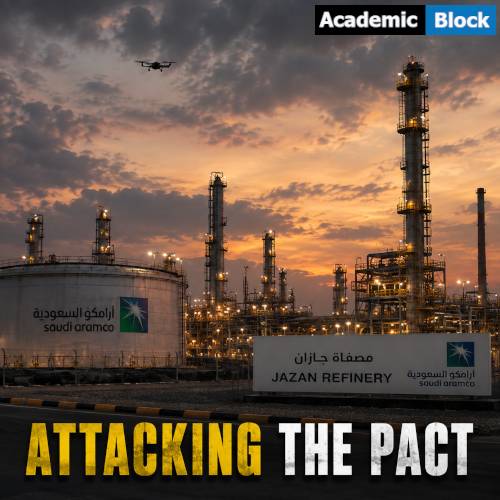
First Test for Pakistan Turkey and Saudi Defense Pact as Houthis claim Attack on Saudi oil facility
Yemen’s Houthi rebels said on Sunday that they had carried out a drone attack on a major Saudi oil facility. The claim came just two days after Saudi Arabia signed a mutual defense agreement with Turkey and Pakistan. The timing has raised immediate questions about the strength of this new alliance. The agreement was presented as a way to strengthen regional security at a time when attacks and military confrontations have spread across the Middle East. This incident marks an first real test of the new pact.
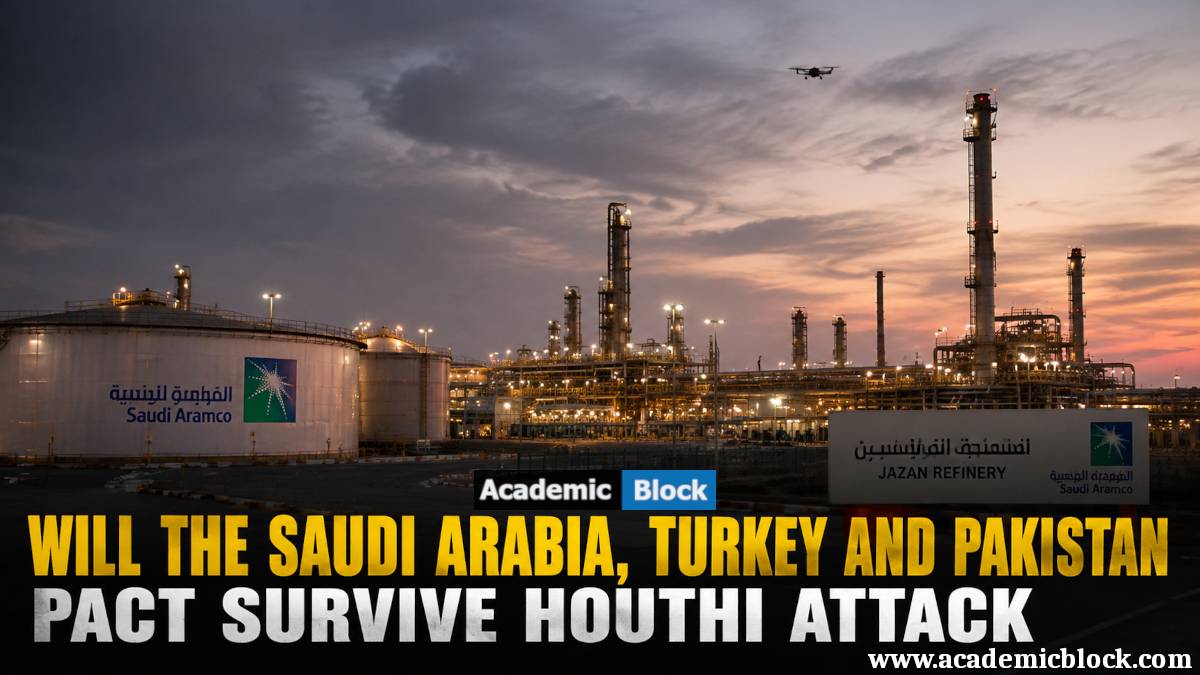
The agreement says that an attack on one member will be considered an attack on all three. Turkish Foreign Minister Hakan Fidan has compared the arrangement technically to NATO’s collective-defense principle, although the agreement does not establish a NATO-style military command structure. Strength of this pact will be judged based on the reaction of Turkey and Pakistan after this attack.
Current Situation of Pakistan, Turkey and Saudi Arabia
To understand the expectations of these countries from this pact, we need to understand their economical and geopolitical situation.
Pakistan
Pakistan with the current population of 255.2 million, GDP of nearly $400 billion and indirect military rule, it is in the most dire situation among all three members. In addition to severe poverty, nearly all the province of Pakistan is undergoing homegrown civil unrest, people are demanding separation from the state. In several provinces of Pakistan, the government’s authority has become almost non-existent. Local population has turned against the system, and is demanding freedom. Pakistan’s Interior Minister Mohsin Naqvi himself remarked on July 30, 2026 that “The system we are living under has collapsed. Problems cannot be solved through it”.
External situation is also bad for the Pakistan, nearly 30 to 40% of the country’s budget goes in repaying the interest on the loans. Two of it’s borders, one with India and other with Afghanistan are extremely unstable to say the least. With high inflation and high unemployment rate, Pakistan’s economy is in turmoil, without the continuous external financial loans the country will collapse.
Turkey
Turkey, with a population of about 85.9 million and a GDP of roughly $1.6 trillion, is economically far stronger than Pakistan, but it is struggling with a prolonged inflation crisis. Consumer prices were still rising at more than 32% annually in June 2026, while unemployment remained around 8%. The country’s economic troubles have been compounded by years of high inflation, currency weakness and tight monetary policy. Although Turkey’s economy continues to grow, the World Bank has recently cut its 2026 growth forecast to 2.8%, citing the impact of the conflict in the Middle East, higher energy prices and tighter financial conditions.
President Recep Tayyip Erdoğan faces a difficult domestic environment, political tensions with the opposition have intensified, and the government continues to face criticism over its treatment of political opponents and promoting hardline Islam. At the same time, Ankara is attempting to resolve its decades-long conflict with the PKK, a process that could either remove a major security problem or create new political tensions.
Externally, Turkey is surrounded by some of the Middle East and Europe’s most complicated security challenges. Its unresolved differences with Greece and Cyprus, its Kurdish conflict, its military involvement in Syria and Iraq, its NATO membership, and its delicate relations with Russia and other regional powers could make the new alliance considerably more complicated than a straightforward three-country defense arrangement.
Saudi Arabia
Saudi Arabia, with a population of about 37 million and a GDP of roughly $1.28 trillion, is by far the strongest economy among the three members of the pact. Unlike Pakistan and Turkey, it is not facing a major inflation crisis; consumer-price inflation remained below 2% in early 2026. The economy also recorded 4.5% real GDP growth in 2025.
Under Mohammed bin Salman, Saudi Arabia has undergone one of the most ambitious transformations in its modern history. As the driving force behind Vision 2030, MBS has pushed the kingdom to reduce its dependence on oil and expand sectors such as tourism, technology, entertainment, manufacturing and renewable energy. His government has also opened Saudi society, worked on women rights, while expanding infrastructure and seeking to attract foreign investment and position the country as a major global business and tourism destination.
However, the kingdom’s biggest economic vulnerability remains its dependence on hydrocarbons, even as Riyadh pushes ahead with its Vision 2030 diversification program. The recent conflict and Houthi threats to energy infrastructure have highlighted a vulnerability that Saudi Arabia has been trying to reduce. In-addition, though Saudi host most advanced defense infrastructure among the three countries, small population size limits it’s ability to have a significant number of military personals and a effective army.
Potential Challenges for this Defense Pact
On the surface this pact looks quite straight forward, however there are many challenges and unanswered questions. There is a significant difference between rhetoric and putting actual boots on the ground. Last year Pakistan and Saudi has inked the similar defense pact. Since then there have been multiple attacks on Saudi by Iran and Houthis, but Pakistan could not do anything other than issuing some statements.
There is a issue of perception also, the way all three countries have announced this pact, globally it considered as a “Muslim NATO”, some are also calling it as “Sunni NATO”. For the domestic politics, both in Turkey and Pakistan, this pact is subtlety presented as a new sign of global Muslim unity. This image itself may prove to be counter productive, as it may prompt other non-islamic countries to form blocks of their own. It remains to be seen whether Turkey and Pakistan help Saudi militarily against Houthis, or Iran. Currently the answer seems to be a NO.
Web Resources on Pakistan, Turkey and Saudi Defense Pact
1. CNN.com : Saudi Arabia turns to Muslim military heavyweights in landmark defense pact as Iran war closes in.
2. BBC.com : Saudi Arabia, Turkey and Pakistan sign defence pact.
3. AcademicBlock.com : Saudi Arabia, Pakistan and Turkey to Sign Defence Pact in Jeddah.