

Rohingya A Troubled Past and Uncertain Future
For generations, Rohingya communities have lived in Myanmar’s Rakhine State, along the country’s western border with Bangladesh. Yet Myanmar has largely refused to recognize them as one of the country’s indigenous national groups. Hundreds of thousands have been driven from their homes in successive waves of violence. More than one million now live outside, most of them in Bangladesh. But is there more than what meets the eye?
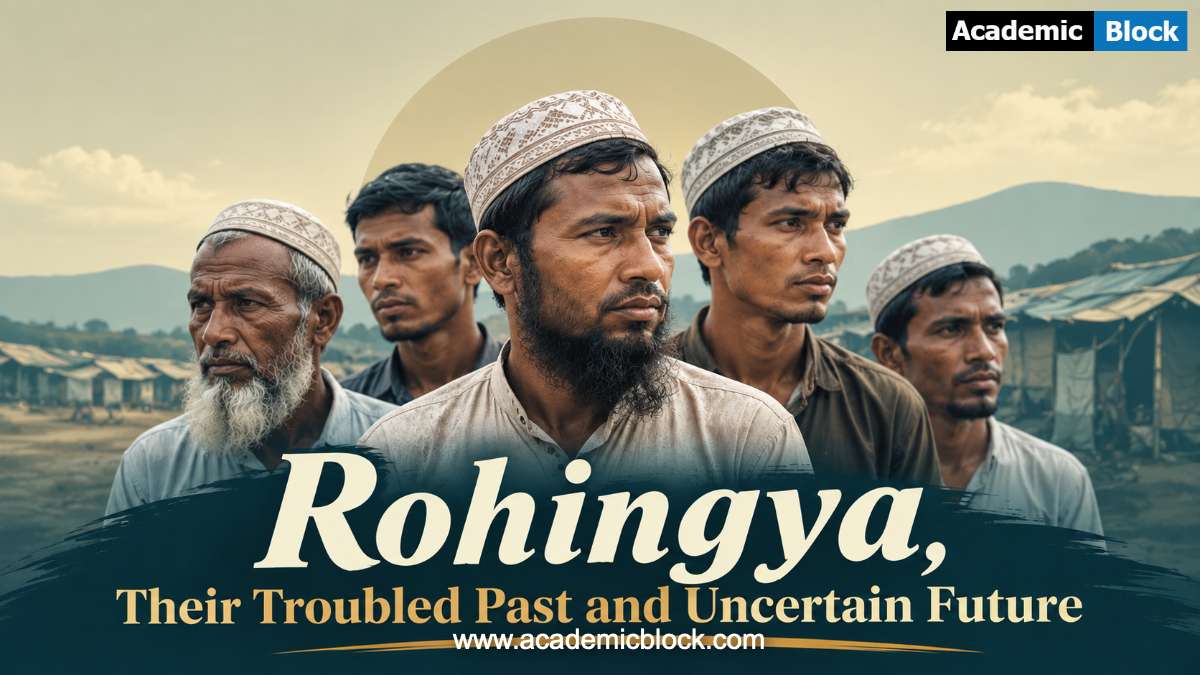
The crisis is often presented as a conflict between Buddhists and Muslims. But the story is far more complicated. It has been shaped by colonial migration, ethnic nationalism, competing claims over land, citizenship, armed insurgency and, increasingly, the reluctance of other countries to absorb a population that has spent years in exile.
Who Are the Rohingya?
The Rohingya are a predominantly Sunni Muslim ethnic minority from Myanmar’s Rakhine State, which was historically known as Arakan. Their language is closely related to Bengali varieties spoken across the border, although Rohingya identity has developed within the historical and cultural environment of Rakhine.
Their history in the region predates modern Myanmar. Muslims had established connections with Arakan centuries ago, while the region also maintained close links with Bengal. The modern population, however, was shaped by several different periods of migration and settlement. That distinction became critical during British rule.
How British Rule Changed the Rohingya Equation
Britain conquered Arakan in the First Anglo-Burmese War in 1826 and eventually incorporated Burma into British India. Under colonial rule, people moved across the region in much larger numbers.
Workers and migrants from other parts of British India entered Burma to work in agriculture, administration, commerce and infrastructure. Some settled permanently. Migration between Bengal and Arakan increased because the colonial administration did not treat the border as the hard international boundary it would later become.
However, this migration left a deep political legacy. Many Burmese nationalists later viewed Muslim migration as evidence of foreign settlement and economic domination. Anti-Muslim riots occurred during the colonial period. During the Second World War, violence between Buddhist and Muslim communities in Arakan intensified, with communities fleeing in both directions. After independence in 1948, the question changed. The issue was no longer simply who had migrated under British rule. It became a question of who belonged to the new Burmese nation.
Are Rohingya Trouble Makers in Myanmar
Another interesting analysis on this topic is, whether Rohingya are absolute innocent victims or there is a shared blame to go around. There is documented evidence that non-Muslims, especially Hindus and ethnic Rakhine Buddhists were initial victims of violence by Rohingya armed groups and, in many cases, Rohingya civilians in northern Rakhine. This is an important part of the history that is sometimes omitted when the conflict is described solely as persecution of Rohingya by the Myanmar state.
In Rakhine, Buddhists historically became a minority relative to Muslims in northern parts of the state. During the British rule, migration from Bengal substantially increased the Muslim population. Many Rakhine Buddhists came to see this not simply as immigration but as colonial demographic replacement. They were also the victims of violence by Rohingya community in general.
Amnesty International has also found that local Rohingya villagers in ordinary clothing participated alongside ARSA fighters in rounding up the Hindu villagers. One survivor reported being told that Hindus and Rakhine Buddhists could not live there because they had a different religion.
The Hindu massacre of 2017 demonstrates that Rohingya armed actors could themselves reproduce the same kind of ethno-religious exclusion that Rohingya communities were experiencing in the Myanmar state. It can’t be said honestly that members of Rohingya community did not initiate or participate in the violence against Buddhists and Hindus, though they lost in the end. There is established history of severe violence carried out by Rohingya groups against non-muslims communities in Myanmar.
From Ethnic Dispute to Rohingya Citizenship Crisis
The post-independence government struggled to define citizenship in a country containing dozens of ethnic groups. For the Rohingya, the situation has gradually deteriorated.
The turning point came with the 1982 Citizenship Law. The law created different categories of citizenship and placed particular importance on membership in officially recognized national races or proof of ancestry before 1823, the beginning of the First Anglo-Burmese War. In practice, the Rohingya were largely excluded from full citizenship and many became effectively stateless.
That legal exclusion had consequences far beyond nationality papers. Rohingya people faced restrictions on movement, education, employment, marriage and access to public services. A community that had already been politically marginalized was gradually pushed into a position in which it had fewer legal protections than most other ethnic communities in Myanmar.
The Expulsions That Came Before 2017
The crisis did not begin in 2017. In 1978, a military campaign known as Operation Nagamin, or Dragon King, was launched to screen the population for foreigners. More than 200,000 Rohingya fled to Bangladesh amid allegations of abuses by security forces. Most eventually returned under a repatriation agreement.
Another major exodus occurred in 1991 and 1992. More than 250,000 Rohingya crossed into Bangladesh. Again, most eventually returned under a repatriation program. But the underlying problem had not been solved. The Rohingya still lacked secure citizenship. Their political status remained disputed. And communal tensions between Rohingya Muslims and the Buddhist Rakhine population remained high.
2017: Rohingya Exodus That Changed Everything
On Aug. 25, 2017, the Arakan Rohingya Salvation Army, or ARSA, attacked security posts and non muslim civilians in northern Rakhine State. The attacks were later retaliated by a massive military operation. Myanmar’s security forces and allied forces at that time were accused of killing civilian Rohingya, burning villages, and driving the population across the border. More than 750,000 Rohingya fled to Bangladesh in the months that followed.
However, the violence was not limited to abuses committed against Rohingya. ARSA and associated Rohingya fighters committed serious crimes against civilians. Amnesty International documented massacres of Hindu villagers in northern Rakhine and concluded that ARSA had killed and abducted members of the Hindu community in large numbers.
Those crimes are an important part of the history. They demonstrate that the conflict was not a simple story of one community acting against another. Armed groups on the Rohingya side also committed heinous atrocities. But the scale of the military campaign against the Rohingya population was vastly greater. The 2017 crackdown produced one of the world’s largest refugee movements in decades.
Bangladesh Became Their Refuge
Bangladesh opened its border to the enormous influx. More than 700,000 Rohingya arrived in 2017 alone. They joined earlier waves of refugees who had already been living in Bangladesh. Today, more than one million Rohingya refugees are registered in Bangladesh, most of them living in the enormous settlements around Cox’s Bazar.
However, Bangladesh has never said that it wants the Rohingya to remain permanently. There are allegations from Indian side that, Bangladesh is pushing large groups of Rohingya into its territory.
And the World Has Not Opened Its Doors
This is perhaps the most uncomfortable part of the Rohingya story. The international community has repeatedly condemned the persecution of the Rohingya. Muslim-majority countries have raised the issue through the Organisation of Islamic Cooperation (OIC). Western governments have imposed sanctions and supported humanitarian assistance. International courts have examined allegations of genocide and other serious crimes.
The result is a strange imbalance. Many Islamic countries say that the Rohingya have the right to live safely and with dignity. But no Muslim-majority country is willing to accept large numbers of Rohingya as permanent residents. Leaders like Recep Tayyip Erdoğan from Türkiye has used loud Rhetoric in favor of Rohingya problem, but on ground Türkiye has not takin in any significant Rohingya population. Most of Rhetoric seems designed for stroking emotions in local population, to gain political millage both domestically and internationally.
Also, muslim countries such as Pakistan, Saudi Arabia, and others have provided various forms of political support, but none has offered to permanently absorb anything close to Bangladesh’s contribution.
Even the Host Countries Are Becoming Restless
The pressure is no longer limited to Bangladesh. Rohingya refugees have increasingly attempted dangerous sea journeys toward Malaysia, Indonesia and other countries. The journeys have become more frequent as conditions in Bangladesh have deteriorated and hopes of returning to Myanmar have faded.
The sea route has become deadly. UNHCR reported that nearly 900 Rohingya were reported dead or missing at sea in 2025, making it the deadliest year on record for Rohingya maritime movements. More than 500 people were feared dead or missing after two boats disappeared in the region in mid-2026.
Malaysia has also become increasingly concerned about the long-term presence of refugees. In August 2026, Malaysia and Myanmar agreed on a voluntary repatriation program that includes 5,000 Rohingya, with the first group scheduled to return in September.
Indonesia has faced similar tensions. In Aceh, where Rohingya boats have repeatedly arrived, local opposition has grown as communities have become concerned about the number of arrivals and the burden placed on local resources.
Why Has the World Become Reluctant?
Rohingya armed groups, criminal networks and trafficking operations have become part of the regional security discussion. The existence of these groups does not make ordinary Rohingya refugees responsible for their actions. But it has nevertheless affected how some governments view new arrivals. Radicalization is also another issue with Rohingya, for example in India many of the Rohingya are caught supporting Islamic Terrorist organizations, this inturn has changed the public opinion against them.
In-addition, refugee policy is increasingly unpopular in many countries. Governments have become more concerned about housing, employment, public services, border control and social tensions. The Rohingya have therefore entered the same political debate that surrounds refugees in many parts of the world.
Bangladesh, Malaysia and other host countries do not want temporary refugee camps to become permanent cities. They fear that accepting permanent settlement could transform a temporary humanitarian response into a long-term demographic commitment.
The Way Forward
There is no quick solution. A sustainable answer would probably require several things to happen. Like, Bangladesh needs greater international burden-sharing. Humanitarian funding cannot be allowed to collapse while more than a million people remain dependent on it. No country can realistically take the entire population. But if more Islamic governments accepted meaningful numbers, the burden on Bangladesh would be reduced and a limited number of refugees would gain a genuine long-term future.
Finally, Rohingya political representatives must be part of the settlement. A solution imposed entirely from outside is unlikely to survive. Still the most troubling fact is that, after decades of displacement, the Rohingya still have no country that is prepared to say, unequivocally, that they belong.
Web Resources on Rohingya
1. France 24: Welcome no more, Rohingya face backlash in Bangladesh.
2. Academic Block: 250 Rohingya refugees and Bangladeshi nationals are Missing After Migrant Boat Sinks.
3. Daily Star: Rohingya, people not wanted anywhere.
4. UNHCR: Rohingya Refugee Crisis Explained.
5. Reuters: Rohingya face rejection in Indonesia after surge of boat arrivals.
6. BBC News: Rohingya refugees face fierce new wave of hostility in Malaysia