
Japan Inc Expands India Investment as China Risks Rise
India’s Commerce Minister Piyush Goyal led the country’s largest-ever business delegation to Japan last week. The visit aimed to strengthen trade and investment ties between the two countries.The visit came as Japanese companies have increased their focus on India amid rising geopolitical tensions and supply-chain risks. India has ranked first for four consecutive years in the Japan Bank for International Cooperation’s survey of promising overseas destinations. More than 60% of surveyed Japanese firms have backed India for future expansion. Japan has also set a 10 trillion yen, or about $68 billion, private-sector investment target for India by 2035. The target underlines India’s growing importance in Japan’s global business strategy.
India has also benefited from the broader “China Plus One” strategy, as Japanese banks, manufacturers, retailers and technology firms expand their operations. Its large domestic market, growing industrial base and skilled workforce have made India an increasingly attractive long-term growth market. In addition, stronger government and business ties have given bilateral economic relations fresh momentum. Japanese companies are therefore diversifying their global operations while seeking greater supply-chain resilience. As this shift continues, India has emerged as a key pillar of Japan Inc’s strategy to reduce concentration risks and secure sustainable future growth.
Why India Has Become a Major Growth Bet for Japan Inc
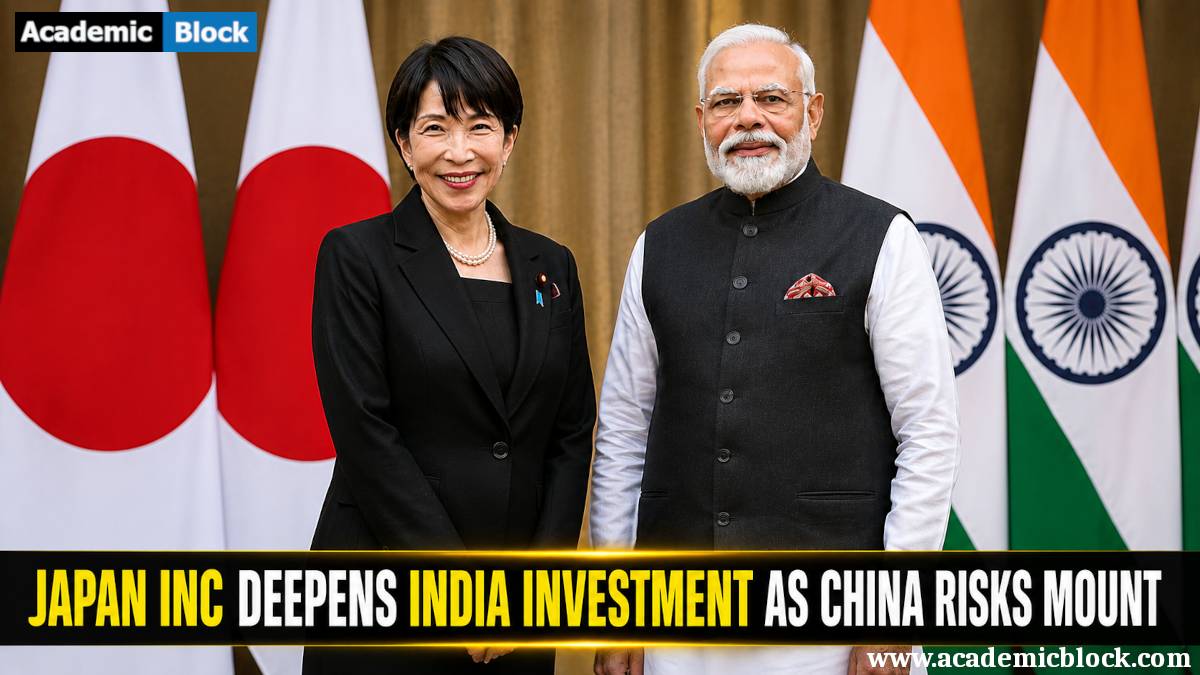
Prime Minister Sanae Takaichi visited India from July 1 to 3, 2026, and met Prime Minister Narendra Modi in New Delhi. The summit strengthened economic ties, as both countries issued a joint declaration on economic security covering semiconductors, critical minerals, information technology, clean energy and pharmaceuticals. They also signed separate declarations on artificial intelligence and energy security. Japan has remained a major investor in India, ranking as the fifth-largest investor since April 2000, with total investment reaching about $48 billion, according to Indian government figures. Bilateral trade also exceeded $27 billion in 2025-26, while both governments have set their sights on further expanding commercial ties.
Uniqlo, Muji, Onitsuka Tiger, Nitori and Lawson have expanded their presence, while Japanese banks have increased their exposure. MUFG invested $4.4 billion for a 20% stake in Shriram Finance, and SMBC acquired 24.22% of Yes Bank. More than 100 Japanese companies also operate Global Capability Centres in India, supporting research, AI and corporate strategy. Japanese companies announced about $12.5 billion through 120 agreements during Takaichi’s visit, while Japan and India reaffirmed the 10 trillion yen private investment target. However, tax complexity and approval hurdles remain challenges. Even so, India’s market potential has made it one of Japan Inc’s most important bets for future growth.
China Risks Push Japanese Companies to Diversify Beyond China
Japanese companies have faced growing risks from US-China trade tensions, supply-chain dependence and China’s slower economic growth. A JETRO survey found that 72.1% of Japanese firms have seen rising geopolitical risks affecting their businesses. Also, 68.3% have identified US-China relations as a major concern. Stronger competition from Chinese companies and changing regulations have added further pressure. However, heavy dependence on China can quickly disrupt production, sales and investment when trade restrictions or supply shocks emerge. As a result, Japanese companies have increasingly looked beyond China to build more resilient and diversified supply chains.
In 2026, China’s export controls have added fresh pressure on Japanese businesses. Japan’s rare-mineral imports from China have also fallen by about 44% year on year. China has additionally imposed restrictions on 40 Japanese companies linked to defense, aviation and shipbuilding. In response, Japanese firms have sought alternative sources and expanded operations in other markets. Meanwhile, Toyota, Honda and Suzuki have increased their manufacturing investment in India. Japan has also reduced its dependence on Chinese rare minerals from about 90% in 2010 to roughly 60%. The shift shows that supply-chain diversification has become a long-term strategy for Japanese companies as they seek greater resilience and less exposure to China-related risks.
Web Resources On Japan Inc Expands India Investment as China Risks Rise
1. BBC : Japan Inc is betting big on India as China risks deepen.
2. Money Control : Japan Inc doubles down on India with record investments as China focus shifts.
3. Financial Express : Japan bets big on India, Megabanks invest record $9 billion in 2025.