
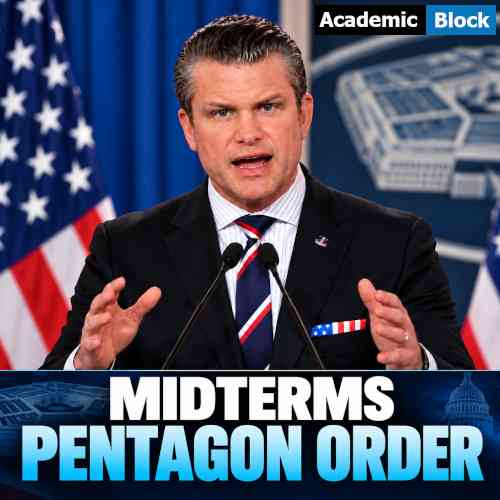
Hegseth Orders US Military to Counter Foreign Threats Ahead of 2026 Midterms
US Secretary of War Pete Hegseth has ordered stronger defenses against potential foreign threats ahead of the 2026 US midterm elections.The directive has instructed US Cyber Command to use existing cyber capabilities to counter foreign election interference. It has also directed defense intelligence agencies to gather information on potential foreign threats and coordinate with the Department of Homeland Security.
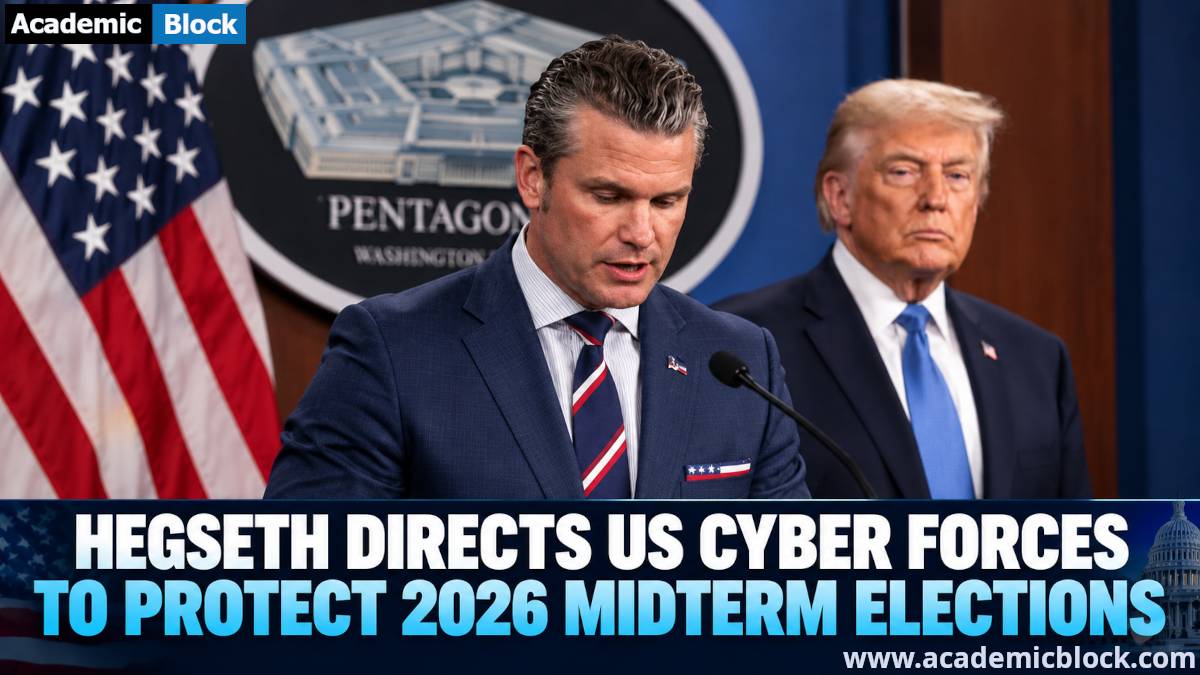
In addition, the Pentagon has described protecting the elections as a “no-fail mission,” highlighting the importance the department has placed on defending the electoral process from potential foreign interference.
Hegseth Directs Pentagon to Use Cyber and Intelligence Tools to Protect 2026 Elections
Defense Secretary Pete Hegseth has directed the U.S. Department of Defense to protect the 2026 midterm elections from foreign interference and potential cyber threats. Under the directive, U.S. Cyber Command will use existing cyber capabilities and legal authorities to identify and counter foreign threats. Meanwhile, the Defense Intelligence Enterprise will collect and produce intelligence on election-related risks. The memorandum also involves senior leaders from the NSA, DIA and NGA, whose activities must follow applicable laws, regulations, executive directions and Defense Department policies. In addition, Cyber Command will coordinate with the Department of Homeland Security (DHS) on threats to election infrastructure.
The plan builds on federal cyber efforts used during the 2022 midterm elections, when the NSA and Cyber Command worked together against foreign interference and threats to election systems. Building on those earlier efforts, federal agencies will use existing cyber and intelligence resources to address foreign threats while staying within their legal authorities as the Nov. 3 election approaches.
US Election Security Takes on Wider China-Russia Cyber Dimension
Hegseth’s directive puts Pentagon cyber and intelligence capabilities at the center of efforts to counter potential foreign threats to the 2026 U.S. midterm elections. However, it does not accuse China or Russia of planning election interference or name either country as a target. The 2026 Annual Threat Assessment says China, Russia, Iran and North Korea will continue seeking to compromise U.S. government and private-sector networks and critical infrastructure. It identifies China and Russia as persistent and active state-level cyber threats, while also highlighting Russia’s broader pressure and China’s growing political, economic, military and technological influence.
Election threats also extend beyond voting systems. Foreign actors can use cyber operations, espionage and information operations to obtain voter data, disrupt government or news websites, spread false claims and create uncertainty around results. Attacks on critical infrastructure can also affect public confidence. Hegseth’s directive therefore links existing Pentagon cyber and intelligence tools to the wider effort to counter foreign threats.
Web Resources On Hegseth Orders US Military to Protect 2026 Midterms
1. CNN : Hegseth directs military to defend US midterm elections from foreign interference.
2. The Hill : Hegseth instructs Pentagon to defend 2026 elections from ‘foreign actors’.
3. AcademicBlock : ‘Pink Slime’ The way AI narrative is Manipulated to Affect Votes.
4. AP News : Hegseth says national security, military cyber forces will guard US election systems during midterms.
5. USA Department of War : Secretary of War Pete Hegseth Signs Directive to Defend 2026 Elections From Foreign Threats.