

‘Pink Slime’ The way AI narrative is Manipulated to Affect Votes
The phrase “pink slime” once described a particular kind of political-looking website that was designed to resemble a legitimate local news outlet. In 2026, however, the phenomenon has acquired a new dimension. Those websites are no longer reaching only people through social media and search engines. Their stories can also become inputs for artificial-intelligence chatbots that millions of people increasingly use to understand politics and current events.
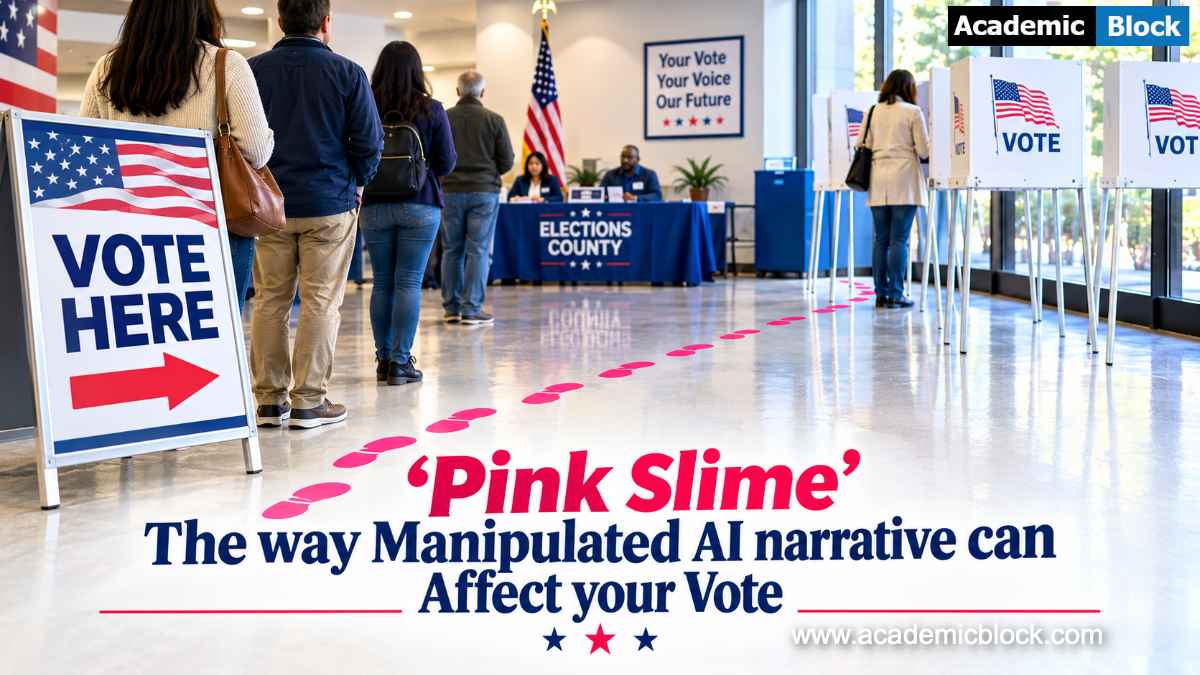
This creates a new information problem. A partisan article may enter the information ecosystem looking like local journalism. An AI system may then retrieve that article, summarize it and present the information in a neutral-sounding answer. The political origin of the material can become much less visible in the process. Recent research and reporting around the 2026 U.S. midterm elections have highlighted this emerging problem. NewsGuard has identified 1,179 websites that it classifies as partisan “pink slime” outlets, including 21 that had launched in 2026. The issue, therefore, is no longer simply whether people can recognize a questionable news website. It is whether they can recognize the same questionable narrative after an AI system has transformed it into an apparently balanced answer.
What Is ‘Pink Slime’ Journalism?
“Pink slime” is a term that has been used for websites that present themselves as local news organizations while having undisclosed or partisan political backing. The name comes from a meat-processing product that was once used as a filler. The analogy is straightforward: the material may look like news, but its underlying composition can be very different from that of independent journalism.
The phenomenon is not new. The Washington Post has previously documented how sites that appeared to be local newspapers published misleading political stories while benefiting from the credibility associated with local journalism. However, now the the scale of this and the technology has grown manifolds. NewsGuard reported in September that its researchers had identified 1,179 such sites. It also said that two partisan networks had spent at least $801,500 on advertising during the first eight months of 2026 to push their articles into Facebook and Instagram feeds.
How the Audit Uncovered the Pattern
NewsGuard, a organization that rates news reliability has tested seven leading AI chatbots. The tools included OpenAI’s ChatGPT, Microsoft’s Copilot, Perplexity, Anthropic’s Claude, Google’s Gemini, Meta AI and xAI’s Grok. Analysts fed the systems prompts based on recent coverage from 12 pink slime sites, six leaning left and six leaning right.
The results were clear. Collectively, the chatbots cited pink slime sites in 48.2 percent of their responses. In 7.7 percent of cases, those sites were the only sources mentioned in the main answer, even though additional sources sometimes appeared in a separate list. ChatGPT cited the sites most often, at 70.8 percent of responses. Grok cited them least often, at 29.2 percent. The other systems fell in between.
The chatbots proved three times more likely to cite left-leaning pink slime sites than right-leaning ones. Left-leaning sites appeared in 36.3 percent of responses, while right-leaning sites appeared in 11.9 percent. Analysts noted that the difference may stem from higher publishing volume on the progressive side rather than any inherent bias in the AI systems. Only one response out of 168 examined by NewsGuard flagged a source as partisan. In nearly every other case, the chatbots treated the pink slime material as ordinary news.
Why the Amplification Matters
Voters increasingly turn to AI chatbots for information about candidates and issues. When a chatbot cites a pink slime site without noting its funding or agenda, the partisan framing can gain an air of neutrality. The flat, authoritative tone that many chatbots use further obscures the origin of the material.
Pink slime operators have also spent heavily on social media advertising to promote their articles. One left-leaning network has spent between roughly $343,000 and $430,000 on Facebook and Instagram ads in 2026, generating tens of millions of views. A right-leaning network has spent between $450,000 and $596,000, with even higher view counts. Those ads can drive readers toward the sites, and the same content can later surface inside chatbot answers.
The strategy is not new. Political actors have long sought to shape media narratives. Yet the combination of opaque local-looking sites and AI systems that scrape much of the open web creates a powerful new channel. Content that might once have reached only a limited audience now travels farther and arrives with greater apparent credibility.
Decline of Local Journalism also helps Pink Slime
There is also a structural problem behind the rise of pink slime. Many communities have lost traditional local news organizations. That has created gaps in coverage that can be filled by organizations presenting themselves as local news outlets.
The Washington Post has previously reported on the decline of local newspapers and the growth of sites that attempt to exploit the credibility associated with local journalism. This matters for AI systems because a lack of independent reporting can leave fewer high-quality sources available on highly local political questions.
If there are five independent newspapers reporting on a local election, an AI system has more opportunities to compare reporting. If those newspapers have disappeared and a collection of partisan websites has filled the information gap, the source environment becomes considerably more complicated. In that situation, producing more content can potentially create more opportunities for a narrative to appear in AI-generated answers.
What Readers Can Do?
The simplest defense remains relatively old-fashioned, check the source behind the answer. When an AI chatbot provides a politically significant claim, reader can examine the cited material rather than relying only on the summary. Always remember everything that you read or watch can not be trusted. If you think that information is too good to be true, then double check its sources.
Web Resources on Pink Slime
1. Politico: Pink Slime Is Infecting AI Chatbots Ahead of the Midterms.
2. NewsGaurd: Pink Slime Oozes Into Battleground States.
3. ABC News: What is ‘pink-slime’ journalism and has it infiltrated Australian media?
4. Guardian: Deluge of ‘pink slime’ websites threaten to drown out truth with fake news.