Forensic Anthropology: Analyzing Bones to Reconstruct Death
Overview
Forensic anthropology is a fascinating field that plays a crucial role in crime scene investigations, mass disasters, and archaeological research. It involves the study of human remains to determine identity, cause of death, and other critical details that help law enforcement solve cases. With advancements in forensic science, forensic anthropology has become an indispensable tool for identifying unknown individuals and bringing justice to victims. In this article by Academic Block, we’ll explore the history of forensic anthropology, its key techniques, modern applications, and the role of forensic anthropologists in criminal investigations. We will also discuss how this discipline contributes to solving mysteries in legal and archaeological contexts.
Introduction to Forensic Anthropology
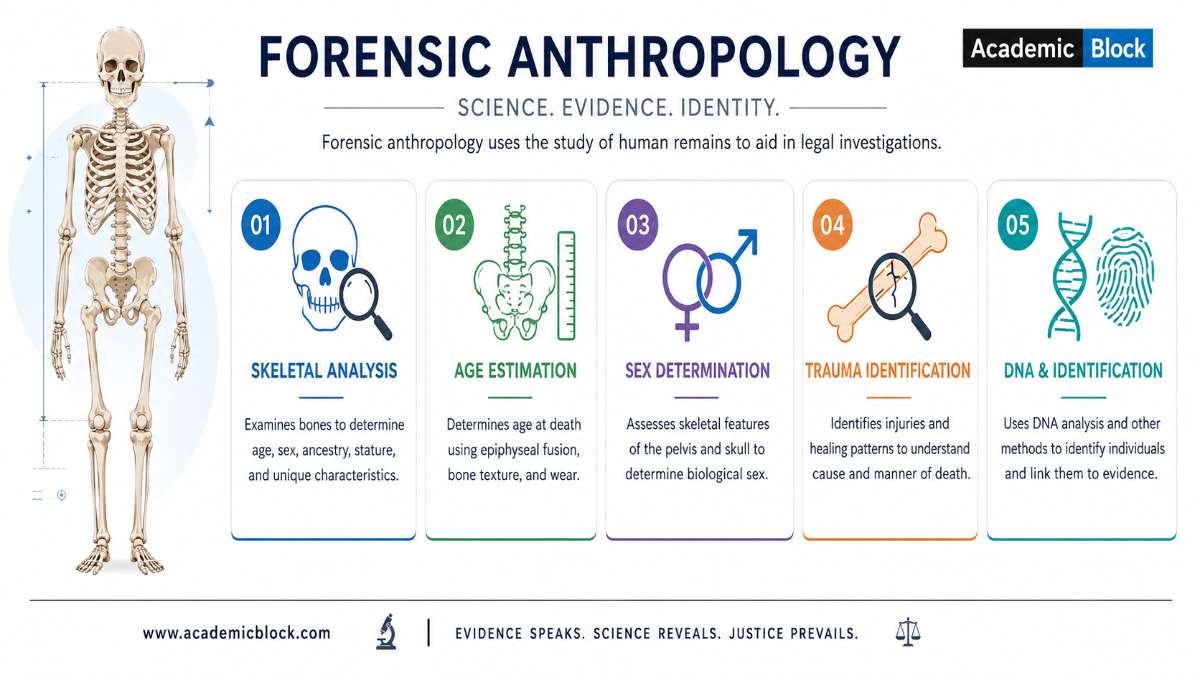
Forensic anthropology is a specialized branch of anthropology that applies biological anthropology and osteology (the study of bones) to legal and criminal investigations. Experts in this field analyze skeletal remains to determine an individual’s age, sex, ancestry, stature, and even signs of trauma or disease.
Forensic anthropologists work closely with law enforcement agencies, medical examiners, and forensic pathologists to help identify unknown human remains and reconstruct events leading to a person’s death. They use advanced scientific techniques, including DNA analysis, radiographic imaging, and 3D reconstruction, to extract valuable forensic evidence.
History and the Growth of Forensic Anthropology
Forensic anthropology has its roots in biological anthropology, but it formally developed as a distinct discipline in the 20th century. Some of the key milestones in its evolution include:
Key Responsibilities of Forensic Anthropologists
Forensic anthropologists perform a range of critical tasks in their work. Some of their primary responsibilities include:
-
Determining Biological Profile : One of the fundamental tasks of a forensic anthropologist is to determine the biological profile of skeletal remains. This includes:-
-
Identifying Trauma and Cause of Death : Forensic anthropologists examine bones for signs of trauma such as fractures, gunshot wounds, blunt force injuries, or sharp force trauma. These analyses help determine whether injuries occurred before, during, or after death.
-
Analyzing Skeletal Decomposition : Understanding postmortem changes is crucial in estimating time since death. Factors such as environmental conditions, insect activity, and decomposition stages provide clues about how long a body has been exposed.
-
Assisting in Crime Scene Recovery : Forensic anthropologists help recover skeletal remains from crime scenes, mass graves, disaster sites, and archaeological digs. They use careful excavation techniques to preserve forensic evidence and document findings for legal cases.
-
Reconstructing Faces and Identities : Using facial reconstruction techniques, forensic anthropologists can create 3D models of a deceased person’s face based on their skull structure. This is often used when other forms of identification, such as fingerprints or dental records, are unavailable.

Techniques and Methods Used in Forensic Anthropology
Forensic anthropology relies on scientific methods and advanced forensic technologies to analyze human remains. Some of the most commonly used techniques include:
-
Skeletal Analysis :
-
DNA Analysis : DNA extracted from bones, teeth, or hair can help identify individuals and establish genetic relationships. Forensic anthropologists work with forensic geneticists to analyze mitochondrial DNA (mtDNA) when nuclear DNA is degraded.
-
Isotopic Analysis : Stable isotope analysis of bones and teeth can provide insights into a person's diet, geographical location, and migration patterns. This is especially useful in identifying remains from historical or mass grave sites.
-
Radiographic Imaging : X-rays, CT scans, and MRI imaging help forensic anthropologists visualize internal bone structures, fractures, and hidden trauma. These tools aid in virtual autopsies and forensic reconstructions.
-
Facial Reconstruction : Forensic artists use 3D modeling software and clay sculpting techniques to reconstruct a person's face based on their skull. These reconstructions can be used for missing person cases and media appeals.
Subfields of Forensic Anthropology
Forensic anthropology is a broad discipline with several specialized subfields that focus on different aspects of human remains analysis. These subfields enhance forensic investigations by applying scientific methods to uncover vital details about an individual's life and death.
(i) Forensic Osteology
- The study of human bones to determine age, sex, ancestry, and stature.
- Helps identify skeletal remains in criminal cases, mass graves, and disaster sites.
(ii) Forensic Archaeology
- Focuses on excavating and recovering human remains from crime scenes, historical sites, and mass burials.
- Uses archaeological techniques to preserve forensic evidence and reconstruct events leading to death.
(iii) Forensic Taphonomy
- Examines postmortem changes like decomposition, insect activity, and environmental effects on the body.
- Helps estimate time since death and detect burial modifications.
(iv) Forensic Facial Reconstruction
- Uses 3D modeling and skull-based reconstructions to recreate an individual's appearance.
- Aids in identifying unknown victims when other forensic methods fail.
(v) Forensic Biometrics and DNA Analysis
- Studies genetic markers in bones and teeth to confirm identity.
- Useful in cold cases, mass disasters, and war crime investigations.
Each of these subfields plays a crucial role in solving crimes, identifying remains, and preserving forensic evidence.

Real-Life Applications of Forensic Anthropology
Forensic anthropology has a wide range of applications in criminal investigations, disaster response, war crime investigations, and historical research. Some notable real-world applications include:
-
Crime Scene Investigations : Forensic anthropologists help identify skeletal remains in homicide cases, cold cases, and missing person investigations. Their expertise provides valuable forensic evidence in court cases.
-
Disaster Victim Identification (DVI) : In large-scale disasters such as earthquakes, plane crashes, or terrorist attacks, forensic anthropologists assist in identifying victims through skeletal remains.
-
War Crime and Mass Grave Investigations : Organizations like the International Criminal Court (ICC) and the United Nations (UN) rely on forensic anthropologists to investigate genocide, war crimes, and human rights violations by analyzing mass graves.
-
Archaeological and Historical Research : Forensic anthropologists contribute to historical and bioarchaeological studies by examining ancient skeletons to learn about past populations, diseases, and cultural practices.
-
Identifying Unclaimed Remains : Forensic anthropologists work in morgues and medical examiner offices to help identify unclaimed or unidentified remains using forensic databases like CODIS (Combined DNA Index System).
Famous Cases Solved By Forensic Anthropology
Several high-profile cases have been solved using forensic anthropology techniques. Here are a few examples:
Best Colleges for Forensic Anthropology
Forensic anthropology is a specialized field that combines principles of anthropology and forensic science to analyze human remains in legal contexts. Several universities in the United States offer esteemed programs in this discipline. Below is a curated list of top institutions known for their forensic anthropology programs:
These institutions are recognized for their rigorous curricula, experienced faculty, and unique research facilities, making them excellent choices for those pursuing a career in forensic anthropology.
Future of Forensic Anthropology
The field of forensic anthropology continues to evolve with advancements in AI, machine learning, and forensic technology. Some emerging trends include:
-
Artificial Intelligence in Skeletal Analysis : AI-powered software can analyze bone patterns, fractures, and trauma more efficiently than manual methods.
-
3D Scanning and Virtual Autopsies : High-resolution 3D scans allow forensic experts to study bones digitally without physical handling, reducing damage and preserving evidence.
-
Forensic Taphonomy Research : New studies on decomposition rates and environmental effects help refine methods for estimating time since death.
Final Words
Forensic anthropology is a powerful tool in solving mysteries, from crime scenes to ancient civilizations. By combining scientific expertise, forensic techniques, and cutting-edge technology, forensic anthropologists help bring justice to victims and provide critical insights into human history. As technology advances, forensic anthropology will continue to play a vital role in criminal investigations, humanitarian efforts, and historical research. Please provide your views in comment section to make this article better. Thanks for Reading!
Questions and answers related to Forensic Anthropology:
Forensic anthropologists typically hold a Ph.D. in anthropology with a focus on human osteology and skeletal biology. While they are not medical doctors, their expertise in analyzing human remains is crucial in legal contexts, assisting in identifying deceased individuals and determining cause of death.
Forensic anthropologists examine human skeletal remains to assess age, sex, ancestry, and stature. They identify trauma, estimate time since death, and assist in identifying deceased individuals, especially in cases involving decomposed or fragmented remains, aiding law enforcement and legal investigations.
The "Big Four" in forensic anthropology refer to the primary characteristics assessed from skeletal remains: age at death, sex, ancestry, and stature. These elements form a biological profile that aids in identifying individuals and understanding their life history and cause of death.
Forensic anthropology encompasses the analysis of human skeletal remains to assist in legal investigations. Its scope includes identifying deceased individuals, determining cause of death, and providing expert testimony in court. It plays a vital role in cases involving decomposed, burned, or otherwise unrecognizable remains.
Forensic anthropology is a subfield of biological anthropology, which is a branch of physical anthropology. It applies principles of osteology and skeletal biology to legal contexts, assisting in the identification of human remains and the determination of cause and manner of death in forensic investigations.
To become a forensic anthropologist, one typically needs a bachelor's degree in anthropology or a related field, followed by a master's or doctoral degree specializing in biological or forensic anthropology. Practical experience through internships and fieldwork, along with certification from recognized bodies, is also beneficial.
Forensic anthropology is used to analyze human skeletal remains in legal contexts. It assists in identifying deceased individuals, determining cause of death, and estimating time since death. This field is crucial in cases involving decomposed, burned, or otherwise unrecognizable remains, aiding law enforcement and legal investigations.
As of September 2025, the average annual salary for a forensic anthropologist in the United States is approximately $87,877. However, salaries can vary based on factors such as location, experience, and level of education, with some professionals earning higher amounts in specialized roles or regions.
Some of the top institutions offering programs in forensic anthropology include the University of Tennessee, Texas State University, and Boston University. These programs provide comprehensive education and training in forensic anthropology, preparing students for careers in this specialized field.
Forensic anthropology has been pivotal in resolving high-profile cases. Notably, Dr. Clyde Snow's analysis of skeletal remains led to the identification of victims in the John Wayne Gacy case. Similarly, the Argentine Forensic Anthropology Team utilized forensic methods to identify victims of the 1976 military dictatorship, exemplifying the field's global impact in human rights investigations.
Forensic anthropologists specialize in analyzing human skeletal remains to determine age, sex, ancestry, and stature. They assess trauma and disease markers, estimate time since death, and assist in identifying individuals. Their expertise is crucial in legal contexts, providing objective analysis to aid in criminal investigations and mass disaster response.
A notable example is the identification of victims from the 1991 Yogurt Shop Murders in Austin, Texas. Forensic anthropologists employed advanced DNA testing and genealogical methods to conclusively link the crimes to Robert Eugene Brashers, providing long-awaited closure to the case and demonstrating the evolving capabilities of forensic science.
Admission to a Master of Science in Forensic Anthropology typically requires a bachelor's degree in anthropology or a closely related field, with coursework in human anatomy, osteology, and statistics. Programs often include practical experience through internships or research projects, preparing graduates for careers in forensic analysis and academic research.
Becoming a forensic anthropologist involves obtaining a bachelor's degree in anthropology, followed by a master's or doctoral degree specializing in biological or forensic anthropology. Practical experience through internships, fieldwork, and research projects is essential. Certification from recognized bodies, such as the American Board of Forensic Anthropology, can enhance career prospects.
Several institutions offer specialized programs in forensic anthropology. Notable examples include Texas State University, which provides comprehensive training in forensic sciences, and Boston University, known for its integration of forensic anthropology within medical sciences. These programs equip students with the necessary skills for careers in forensic analysis and research.
Forensic anthropologists utilize DNA analysis to confirm the identity of human remains, especially when skeletal remains are fragmented or decomposed. Techniques such as mitochondrial DNA testing can link remains to maternal lineages, aiding in identification. DNA analysis also assists in determining biological relationships and can provide insights into the individual's ancestry and health.
Challenges in forensic anthropology include the degradation of remains due to environmental factors, which can hinder analysis. Limited access to advanced technology and resources, especially in underfunded regions, poses additional difficulties. Ethical considerations, such as obtaining consent for the use of human remains, also present ongoing concerns within the field.
While both forensic anthropologists and anthropologists study human beings, forensic anthropologists specialize in analyzing human skeletal remains to assist in legal investigations. They apply their expertise to identify individuals and determine causes of death. In contrast, anthropologists may study human societies, cultures, and behaviors without a specific focus on legal contexts.
Precautions to be used while using Forensic Anthropology
Informed Consent: Obtain informed consent whenever possible, especially in cases involving the study of skeletal remains from indigenous or culturally sensitive contexts. Respect the wishes of the deceased’s community and family members.
Ethical Considerations: Adhere to ethical guidelines and principles, recognizing the cultural and religious sensitivities surrounding the handling of human remains. Consider the potential impact of the analysis on families and communities.
Standardized Protocols: Follow standardized protocols and guidelines for the analysis of skeletal remains. Establishing consistent methodologies enhances the reliability and repeatability of forensic anthropological analyses.
Quality Control Measures: Implement quality control measures in all stages of analysis, including data collection, documentation, and interpretation. Regularly review and validate methodologies to ensure accuracy and reliability.
Interdisciplinary Collaboration: Collaborate with other forensic specialists, such as pathologists, odontologists, and DNA analysts. Effective communication and collaboration enhance the overall accuracy and completeness of forensic investigations.
Record Keeping: Maintain thorough and accurate records of all procedures, observations, and analyses. Detailed documentation is essential for transparency, peer review, and potential legal proceedings.
Confidentiality: Handle all case-related information with the utmost confidentiality. Respect the privacy of individuals and families involved in forensic investigations, and refrain from sharing sensitive details without proper authorization.
Secure Storage: Ensure secure and controlled storage of skeletal remains. Implement measures to prevent unauthorized access, damage, or loss of remains, maintaining the integrity of the forensic evidence.
Training and Certification: Stay updated on the latest advancements in forensic anthropology through continuous education and training. Obtain relevant certifications to demonstrate proficiency in the field.
Consistency in Terminology: Use standardized terminology and communicate findings clearly and accurately. Avoid the use of ambiguous or subjective language that may lead to misinterpretation of results.
Respect for Human Dignity: Approach the analysis of human remains with a deep sense of respect for human dignity. Recognize that the remains represent individuals who were once living members of a community, and handle them accordingly.
Impartiality: Maintain impartiality and objectivity in forensic analyses. Avoid assumptions or preconceived notions that could bias interpretations. The goal is to provide unbiased, scientifically sound information.
Courtroom Testimony: If called to testify in court, present findings clearly and accurately. Ensure that courtroom testimony is based on sound scientific principles and follows established legal procedures.
Continual Professional Development: Engage in continual professional development to stay informed about changes in the field, including advancements in technology, methodologies, and ethical considerations.
Consideration of Limitations: Acknowledge the limitations of forensic anthropology and communicate these limitations appropriately. Transparency about uncertainties or constraints in the analysis is essential for maintaining the integrity of the discipline.
Major Cases solved with help of Forensic Anthropology
Green River Killer Investigation: In the 1980s and 1990s, the Green River Killer, Gary Ridgway, terrorized the Seattle area, murdering numerous women. Forensic anthropologists, including Dr. Kathy Taylor, played a crucial role in analyzing skeletal remains found in remote locations. Their work helped establish links between different crime scenes and contributed to the identification and prosecution of Ridgway.
Kennewick Man: The discovery of the Kennewick Man, a 9,000-year-old skeleton, sparked a legal and scientific debate over ownership and study rights. Forensic anthropologists, led by Dr. Douglas Owsley, conducted extensive analysis on the remains, contributing to the understanding of the ancient individual’s lifestyle and origin. The case highlighted the intersection of forensic anthropology, archaeology, and cultural sensitivity.
Jeffrey Dahmer Case: Forensic anthropologists, including Dr. Jeffrey Jentzen, were involved in the investigation of Jeffrey Dahmer, a serial killer and cannibal. Their analysis of human remains found in Dahmer’s apartment played a crucial role in establishing the identities of the victims and the extent of the crimes.
Clarence Hill Case: Forensic anthropologist Dr. William Maples provided expert testimony in the case of Clarence Hill, a man sentenced to death in Florida. Dr. Maples’ analysis of the skeletal remains helped cast doubt on the reliability of certain forensic evidence, contributing to a reevaluation of Hill’s case and eventual commutation of his sentence.
9/11 World Trade Center Attacks: Forensic anthropologists, including Dr. Bradley Adams, played a vital role in the identification of victims following the 9/11 attacks. Their work involved the analysis of human remains recovered from Ground Zero, using various forensic methods, including DNA analysis and dental records, to identify individuals and provide closure to families.
Case of the Disappeared in Argentina: During Argentina’s military dictatorship (1976-1983), many individuals disappeared, and their remains were often buried in clandestine graves. Forensic anthropologists, such as Dr. Clyde Snow, played a crucial role in the identification of victims by exhuming and analyzing skeletal remains. Their work contributed to truth and reconciliation efforts in the aftermath of the dictatorship.
Anzick-1 Paleoindian Burial Site: The discovery of the Anzick-1 burial site in Montana, dating back over 12,000 years, raised questions about the genetic history of early Native American populations. Forensic anthropologists conducted detailed analyses, contributing to our understanding of the peopling of the Americas and the genetic diversity of ancient populations.
O.J. Simpson Trial: Forensic anthropologist Dr. Richard Jantz provided expert testimony in the O.J. Simpson trial. His analysis of skeletal remains helped establish the time frame of Nicole Brown Simpson and Ronald Goldman’s deaths, supporting the prosecution’s timeline of events.
Identification of John Wayne Gacy’s Victims: Forensic anthropologists, including Dr. Clyde Snow, were instrumental in identifying the victims of serial killer John Wayne Gacy. Their work involved the exhumation and analysis of skeletal remains found in Gacy’s property, leading to the identification of many missing young men.
Pompeii and Herculaneum Archaeological Excavations: Forensic anthropologists, working alongside archaeologists, have contributed to the study of ancient civilizations, such as those in Pompeii and Herculaneum. Their analyses of skeletal remains provide insights into the daily lives, health, and causes of death of individuals in these ancient communities.
Facts on Forensic Anthropology
Age Progression and Facial Reconstruction: Forensic anthropologists may collaborate with forensic artists to create age progression sketches and facial reconstructions based on skeletal remains. This helps in visualizing how a person may have looked at the time of death or in the years following.
Individualization through Skeletal Features: The uniqueness of skeletal features, such as specific shapes of bones and variations in joint surfaces, can contribute to individualization, similar to fingerprinting. These features aid in distinguishing one individual from another.
Taphonomy: Taphonomy is the study of what happens to an organism’s remains after death. Forensic anthropologists consider taphonomic factors, such as scavenging, burial conditions, and environmental factors, to interpret the postmortem history of skeletal remains.
Paleopathology: Forensic anthropologists often study paleopathology, the examination of ancient skeletal remains for evidence of diseases and health conditions. This provides insights into the health and lifestyle of past populations.
Facial Superimposition: Facial superimposition involves overlaying a photograph of a potential missing person onto the skull to determine if the facial features match. This technique aids in visual identification and has been used in various criminal cases.
Decomposition Studies: Forensic anthropologists contribute to understanding the decomposition process by studying donated human bodies in forensic anthropology research facilities, often referred to as “body farms.” These studies help refine time since death estimations.
Use of Non-Invasive Imaging: Non-invasive imaging techniques, such as laser scanning and photogrammetry, are increasingly used in forensic anthropology. These methods allow for detailed documentation and three-dimensional reconstruction of skeletal remains without physical manipulation.
Clandestine Graves: Forensic anthropologists specialize in the identification of clandestine graves, often associated with criminal activities. The recognition of subtle changes in soil color and texture can help locate burial sites.
Zooarchaeology Connection: There is a connection between forensic anthropology and zooarchaeology, the study of animal remains in archaeological contexts. Both disciplines share methods for analyzing skeletal elements but focus on different species for distinct purposes.
Cultural Sensitivity: Forensic anthropologists recognize the importance of cultural sensitivity in their work. They consider cultural practices and beliefs related to death and burial, respecting the diverse perspectives surrounding the treatment of human remains.
International Efforts: Forensic anthropologists often collaborate internationally in cases involving mass disasters, genocide, or human rights violations. Their expertise contributes to truth and reconciliation efforts worldwide.
Educational Programs: Many universities and institutions offer specialized educational programs and degrees in forensic anthropology, training the next generation of professionals in this fascinating field.
Ethical Considerations: Forensic anthropologists adhere to strict ethical guidelines, ensuring the respectful and responsible handling of human remains. This includes obtaining informed consent whenever possible and considering the potential impact of their findings on families and communities.
Gender and Diversity Studies: Forensic anthropologists engage in research on gender and diversity, examining how skeletal features vary among populations. This research contributes to a better understanding of human biological variation.
Academic references on Forensic Anthropology
- White, T. D., Black, M. T., & Folkens, P. A. (2011). Human Osteology (3rd ed.). Academic Press.
- Byers, S. N. (2011). Introduction to Forensic Anthropology: A Textbook (4th ed.). Pearson.
- Blau, S., & Ubelaker, D. H. (Eds.). (2019). Handbook of Forensic Anthropology and Archaeology (2nd ed.). Routledge.
- Dirkmaat, D. C. (Ed.). (2017). A Companion to Forensic Anthropology. Wiley-Blackwell.
- Iscan, M. Y., & Kennedy, K. A. R. (Eds.). (2017). Reconstruction of Life from the Skeleton (2nd ed.). Wiley.
- Ubelaker, D. H. (Ed.). (2008). Forensic Science: Current Issues, Future Directions. Wiley-Blackwell.
- Symes, S. A. (Ed.). (2013). Forensic Anthropology: Case Studies from Europe. Charles C Thomas Publisher.
- Dirkmaat, D. C., & Cabo, L. L. (Eds.). (2011). Forensic Anthropology: Contemporary Theory and Practice. CRC Press.
- Byers, S. N., & Jantz, R. L. (Eds.). (2005). Forensic Anthropology: Contemporary Theory and Practice. Pearson.
- Haglund, W. D., & Sorg, M. H. (Eds.). (2002). Forensic Taphonomy: The Postmortem Fate of Human Remains. CRC Press.
- Steadman, D. W. (2015). Hard Evidence: Case Studies in Forensic Anthropology (2nd ed.). Prentice Hall.
- Maples, W. R., & Browning, M. (Eds.). (1994). Dead Men Do Tell Tales: The Strange and Fascinating Cases of a Forensic Anthropologist. Broadway Books.
- Ousley, S. D., & Jantz, R. L. (Eds.). (2012). Forensic Anthropology in the 21st Century: Reflections on Practice and Theory. Springer.
- Pickering, R. B., & Bachman, D. (Eds.). (2009). The Use of Forensic Anthropology (2nd ed.). CRC Press.