
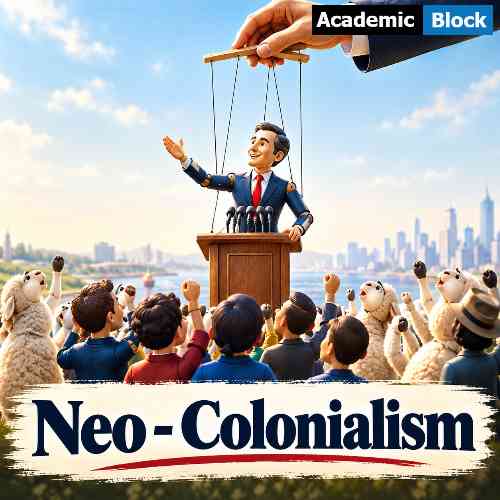
Neocolonialism: The New Face of Colonialism by Global Powers
The age of formal colonialism has largely ended. Across Asia, Africa and other parts of the developing world, colonial flags have been lowered, foreign administrations have withdrawn and independent governments have taken their place. Yet the end of colonial rule did not necessarily end the unequal relationships that colonialism had created.
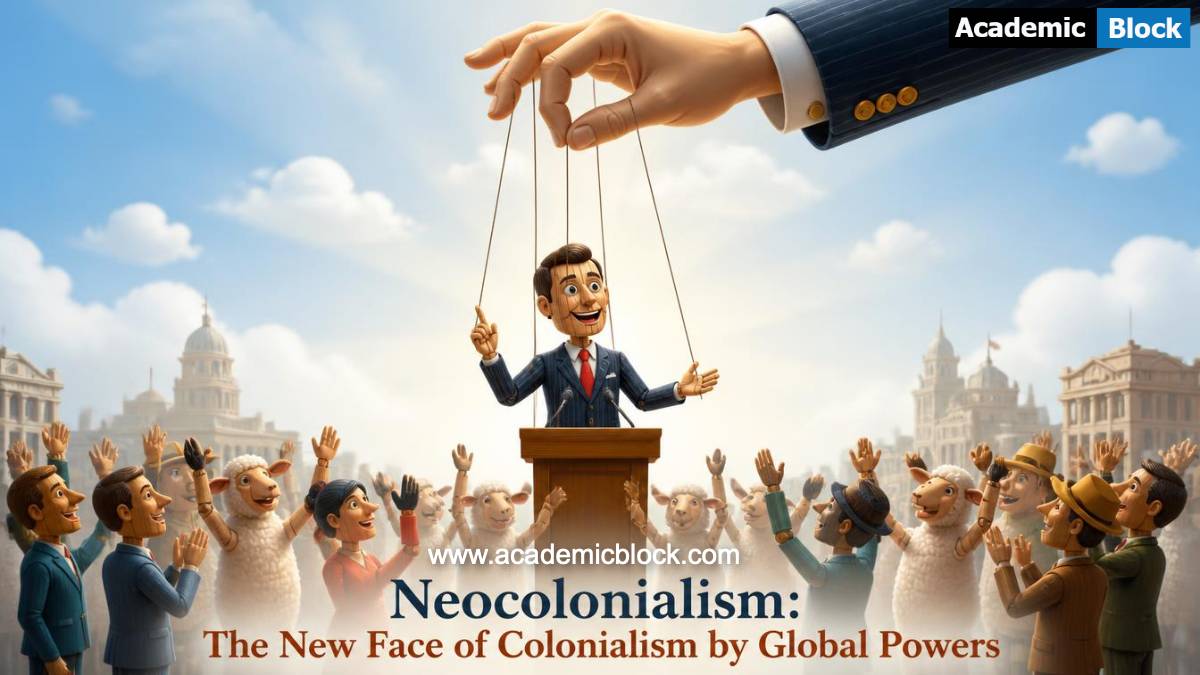
A different form of influence has emerged. It does not usually require an occupying army or a foreign governor. Instead, it can operate through trade, finance, investment, cultural influence., diplomacy, military alliances and social media. This system is commonly described as Neocolonialism.
The debate has moved beyond the question of whether colonialism has ended. It now asks a more difficult question: Can a country be politically independent while remaining economically and strategically dependent on more powerful nations?
Origins of the Concept of Neocolonialism
The term Neocolonialism first appeared in the writings of Jean-Paul Sartre. He used it in his 1964 work on colonialism. African leaders soon gave the idea clearer definition. At the All African People’s Conference in 1961, delegates described it as the continued survival of colonial systems through political, economic and cultural means. These methods avoided open violence yet still limited true independence.
Kwame Nkrumah, Ghana’s first president, popularized the concept further. In his 1965 book Neo-Colonialism: The Last Stage of Imperialism, he argued that a state can hold the outward signs of sovereignty while its economic system and political policy remain directed from outside. Nkrumah wrote that this arrangement gives the powerful power without responsibility and leaves the weak with exploitation without redress. His analysis has influenced generations of thinkers in Africa and beyond.
From Colonial Rule to Indirect Colonization
Colonialism was based on direct control. A powerful state occupied territory, administered institutions and often controlled the political and economic life of the population. However, Neocolonialism is different. The country remains formally sovereign. It has its own government, constitution, flag and diplomatic representation. However, outside powers may still wield considerable influence over important decisions. Many of such decisions actually go against the very interest of these countries.
The most significant difference is that indirect colonization did not necessarily require the visible presence of a foreign ruler. A country could possess a national government and still face considerable constraints arising from its economic position, strategic relationships or dependence on external technology and expertise. This makes modern power more difficult to identify than traditional colonial rule. There may be no colonial governor, no occupying army and no formal imperial decree. Instead, influence can emerge through a complex network of relationships in which powerful states, corporations and institutions possess greater resources and bargaining power than weaker countries.
That distinction is central to understanding the debate over neocolonialism. The concept does not suggest that every international relationship is a disguised form of colonialism. Countries trade, invest, lend, cooperate and exchange technology for many legitimate reasons, and developing nations themselves make strategic choices. The question arises when those relationships become sufficiently unequal that one side can repeatedly shape the choices available to the other. In that sense, the evolution from colonial rule to indirect colonization is less about the disappearance of power than about the transformation of how power is exercised.
The New Instruments of Power: Loans, Trade and Social Media
Foreign loans
The methods of influence have changed considerably since the colonial era. A powerful country no longer necessarily needs to administer another country’s territory. It can exert influence through economic relationships that have developed between states.
Foreign loans are one such example. When a country faces a financial crisis, it may need assistance from international institutions or foreign governments. Such assistance can provide urgently needed capital. However, lending arrangements can also include conditions that affect government spending, taxation, trade policies or economic reforms. This has created a longstanding debate about the relationship between financial assistance and national sovereignty.
Critics argue that a heavily indebted country may have less freedom to choose its own economic policies. Supporters respond that loan conditions can also be designed to restore financial stability and prevent deeper economic crises. The distinction matters because not every international loan is an instrument of Neocolonialism. The argument depends on how the relationship has operated and whether the borrowing country’s policy choices have been substantially constrained.
International Trade
Trade has also become central to the discussion. Many developing economies have historically depended heavily on exports of commodities such as oil, minerals, agricultural products and other raw materials. At the same time, they may import higher-value manufactured products and advanced technology.
That structure can create an unequal economic relationship. Commodity prices have often been volatile. A fall in the international price of a major export can reduce government revenue and foreign-exchange earnings. A country that has not developed sufficient domestic manufacturing capacity may then have to continue importing expensive finished goods.
Economists have studied how commodity prices, terms of trade and external debt can affect long-term development, particularly in African economies. The concern is therefore not simply that a country exports raw materials. The larger issue is whether it has been able to move further up the value chain. If a nation exports the raw material but imports the finished product, much of the economic value is created some where else.
Social Media and Neocolonialism
The modern version of the debate is also moving into technology. Data has become an important economic resource. Social Media platforms, artificial intelligence, cloud computing, advanced semiconductors and telecommunications infrastructure are increasingly central to national power. Developing countries that depend heavily on foreign technology can face a new form of strategic vulnerability.
If a country’s critical digital infrastructure, social media ecosystem or advanced computing capacity is controlled by companies based elsewhere, its formal political sovereignty may not guarantee technological independence. This has led to growing interest in technological sovereignty and digital self-reliance. The issue has become particularly important because technology now affects almost every major sector, from finance and healthcare to defense and education.
Recently two democratically elected governments, one in Bangladesh and other in Nepal were thrown out, because of the social unrest that got triggered from different social medial platforms. Message was clear, if we control your social media we literally control your country and its government.
How Nations Can Defend Against Neocolonialism?
The strongest defense against dependency may not be isolation. It may be diversification. Countries that have developed stronger domestic industries, broader export markets, better education systems and technological capabilities generally have more options when negotiating with powerful partners.
Regional cooperation can also increase bargaining power. Developing countries have increasingly sought to work together through regional organizations and broader Global South initiatives. Such cooperation has the potential to create larger markets and give smaller economies greater negotiating strength.
The challenge, however, is substantial. Economic and data independence cannot be created overnight. It requires investment, skilled workers, technological capacity, reliable institutions and access to markets. It also requires governments to make difficult choices about how much foreign capital they should accept and under what conditions. The road is long, but walkable.
Web Resources on Neocolonialism
1. IEP:Neocolonialism
2. EBSCO: Neocolonialism
3. PolSci Institute:Neo-Colonialism: Modern Exploitation of Developing Countries by the Developed World