
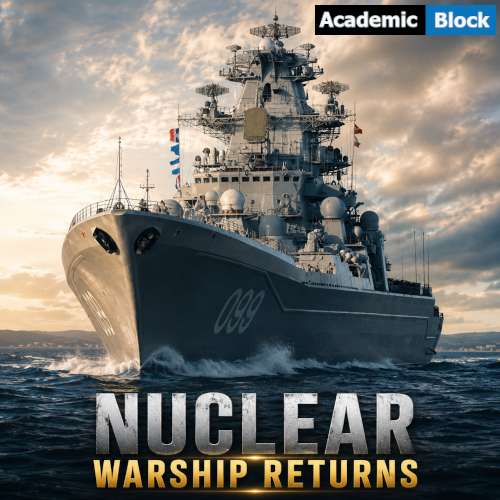
Russia’s 28,000-Tonne Nuclear Cruiser Returns to Sea as NATO Watches
Russia’s largest nuclear-powered surface warship, the Admiral Nakhimov, has returned to operational service after nearly three decades. The modernized Kirov-class battlecruiser arrived at Severomorsk, the headquarters of Russia’s Northern Fleet, after completing extensive sea trials and a years-long modernization program. Its return represents one of the Russian Navy’s most significant post-Soviet naval upgrades and signals Moscow’s renewed focus on expanding its maritime capabilities.
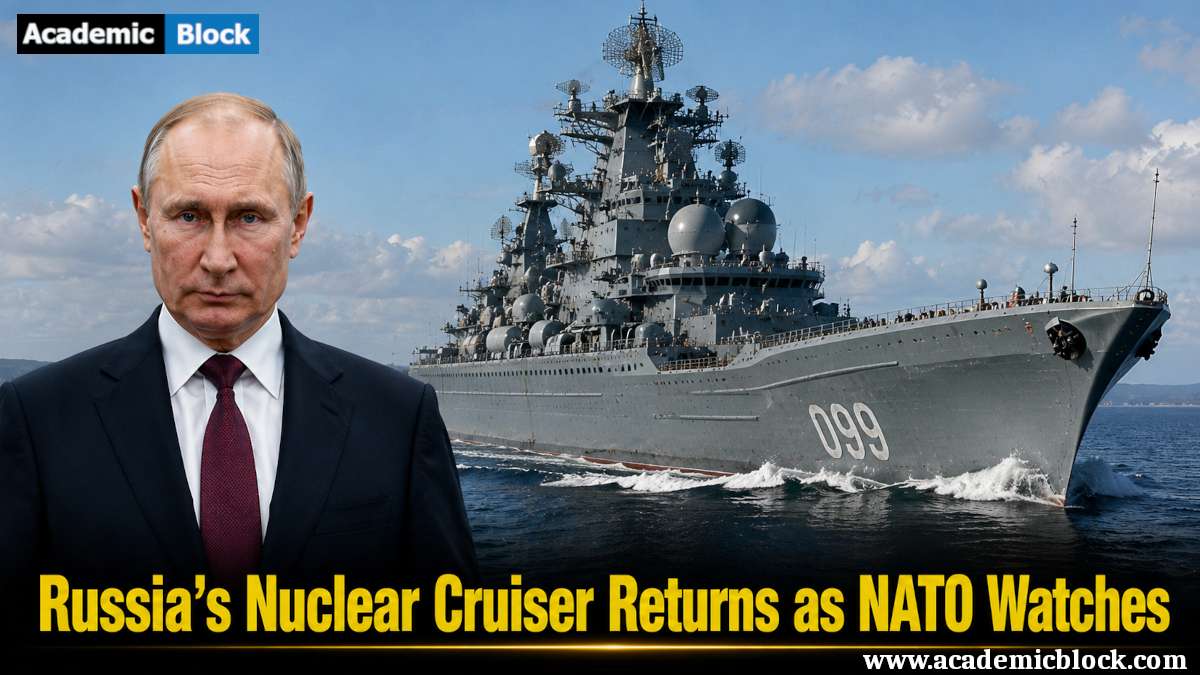
The deployment also places one of the world’s most heavily armed surface combatants near key NATO sea routes. Excluding aircraft carriers, the 28,000-tonne warship remains the world’s largest operational surface combatant. Equipped with Kalibr, Oniks, and Zircon missiles, the cruiser strengthens Russia’s long-range strike capability and increases its operational presence in the strategically important Arctic region.
Modernization Turned Admiral Nakhimov into Russia’s Most Powerful Surface Warship
The Admiral Nakhimov began construction in 1983 and entered service as Kalinin in 1988. Russia renamed the cruiser in 1992, but financial problems after the Soviet Union’s collapse forced it out of service by 1997. It entered the Sevmash Shipyard in 1999, where an initial repair project developed into a modernization program that lasted nearly three decades. Following sea trials in the White Sea in 2025, the cruiser returned to Severomorsk for the first time in 27 years.
The modernization replaced much of the ship’s Cold War-era technology. Engineers overhauled the nuclear reactors, upgraded the radar and combat management systems, and improved the air-defense network. The cruiser now operates with 10 UKSK (3S14) launch modules carrying 80 launch cells for Kalibr, Oniks, and Zircon missiles, supported by Fort-M and Pantsir-M air-defense systems. Although some reports have suggested a future capacity of 174 launch cells, Russia has not officially confirmed that figure.
Why Admiral Nakhimov Matters for Russia and Why NATO Is Watching
The return of the Admiral Nakhimov strengthens Russia’s effort to rebuild its blue-water navy after years of relying on an aging surface fleet. The cruiser is expected to become a flagship of the Northern Fleet, helping Moscow sustain long-range naval operations across the Arctic and North Atlantic. Its nuclear propulsion provides an almost unlimited operating range, while a top speed of 32 knots (59 km/h) allows rapid deployment over vast maritime areas.
For NATO, the deployment highlights Russia’s growing military presence in one of the world’s most strategically important regions. The Arctic and the North Atlantic have become central to regional security as competition between Russia and the alliance has intensified. Although a single warship does not change the military balance, the return of the Admiral Nakhimov enhances Russia’s maritime deterrence and expands its options for future naval operations. As a result, the vessel is likely to remain under close observation by NATO forces operating in the region.
Web Resources on Russia’s Nuclear Cruiser Returns to Sea
1. Times of India : Russia revives 28,000-tonne Cold War nuclear giant with hypersonic missiles, returns to Arctic port.
2. MSN.com : Russia’s 28,000-tonne nuclear cruiser is back at sea and NATO will be watching.
3. Military Watch Magazine : Russia Brings World’s Most Heavily Armed Combat Ship Back to Arctic Port After Sea Trials.
4. Vietnam.vn : Russia’s 28,000-ton ‘nuclear monster’ is about to reappear after three decades.