
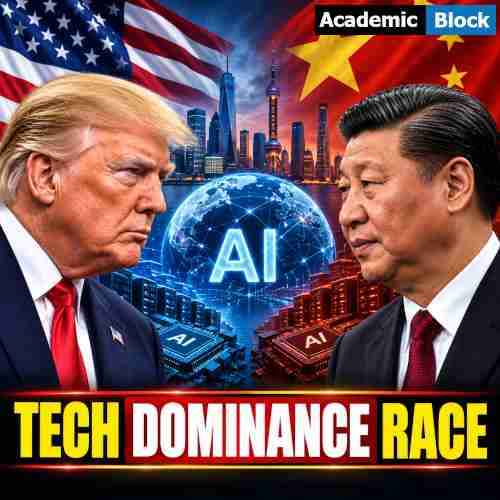
Trump Won’t Slow AI Race as US Seeks to Stay Ahead of China
President Donald Trump has rejected calls to slow artificial intelligence development as the US-China AI race intensifies. Speaking at his golf resort in Doonbeg, Ireland, Trump said the United States remains ahead of China and must protect that advantage. He dismissed concerns from AI scientists and executives at Anthropic, OpenAI and Google, saying, “Whoever wins AI, wins.” His stance reflects a growing debate in Washington over how to balance AI safety with national security and technological leadership.
Chinese President Xi Jinping has taken a different approach. At the BRICS summit in New Delhi, Xi called for greater international cooperation, open-source AI development, and wider sharing of AI technology. China has also proposed a BRICS AI open-source community and deeper cooperation on large language models. The contrasting positions highlight a growing US-China trust gap and show that the AI rivalry is expanding beyond technology companies into a broader contest over global AI standards, governance and influence.
China’s AI Models Are Narrowing the Gap With American Rivals
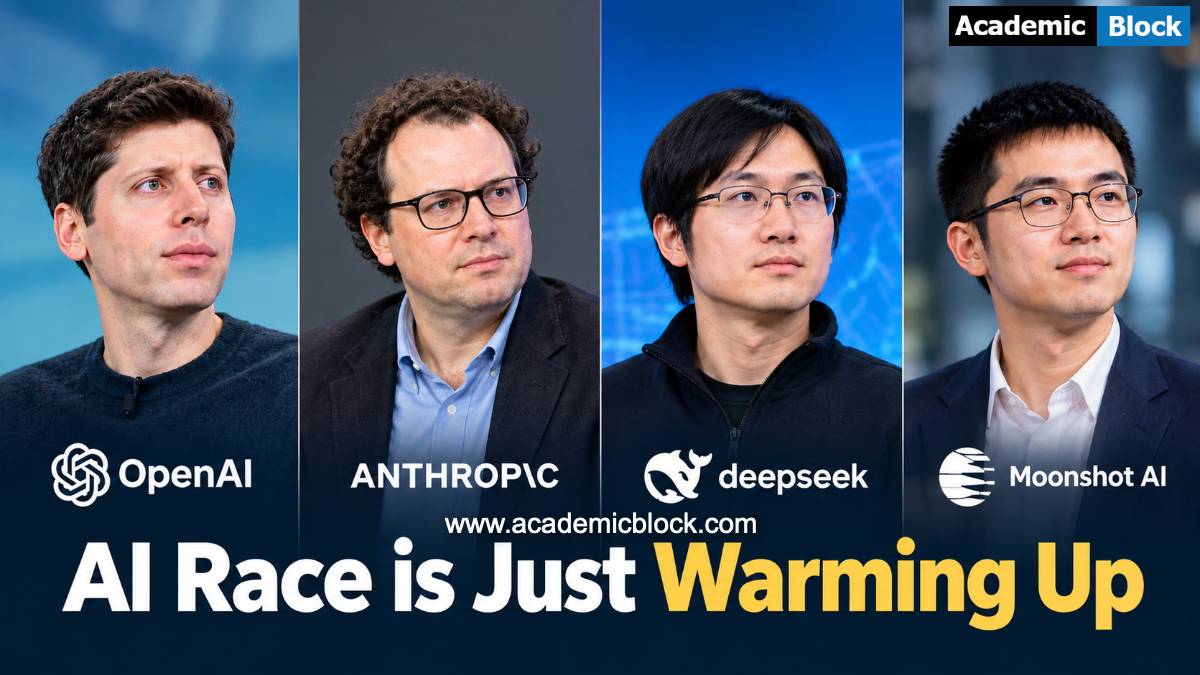
China has faced U.S. restrictions on advanced technologies that support the development of powerful AI systems. However, Chinese developers have continued to make significant progress. DeepSeek gained global attention after demonstrating that a Chinese company could compete more closely with leading American AI developers. In addition, Alibaba, Z.AI, MiniMax and Moonshot have developed increasingly capable AI models. Their progress has raised concerns that the U.S. advantage could narrow. At the same time, the competition has expanded beyond model performance. It now includes intellectual property, computing infrastructure, AI chips and national security, making China’s technological progress an increasingly important strategic issue for Washington.
The dispute has also moved into how AI capabilities are developed. U.S. agencies have accused some China-based AI companies of using knowledge distillation to obtain capabilities from advanced American models. The FBI, NSA and CISA issued a joint advisory on September 8 describing what they called industrial-scale campaigns. Knowledge distillation itself is a legitimate machine-learning technique that allows a less powerful model to learn capabilities from a stronger one. However, U.S. officials allege that some companies have used the technique to obtain restricted proprietary capabilities without authorization. Anthropic has separately said it disrupted unauthorized distillation campaigns linked to several China-based AI laboratories. The dispute shows that the AI race now involves not only technological performance, but also intellectual property, access to computing power and control over critical AI capabilities.
US and China Clash Over Global Rules for Frontier AI
Frontier AI refers to the most advanced artificial intelligence systems at the leading edge of current technology. These models can perform complex tasks involving advanced reasoning, coding, scientific research, data analysis and content creation. They can also work across text, images, audio and video. As Frontier AI has become more capable, it has created opportunities in medicine, science, business and productivity. However, its growing power has also raised concerns about cybersecurity, misinformation, autonomous decision-making, military applications and national security. Governments and AI companies therefore face growing pressure to establish a global AI governance framework. Such rules could cover safety testing, AI autonomy, human oversight, military use, accountability and restrictions on high-risk applications. They may also address the potential harm caused by AI-generated content and determine who should be responsible when AI systems cause damage.
The United States and China, however, have different priorities for such a framework. China has promoted open-source AI, international cooperation and technology sharing, while Beijing argues that national security restrictions should not become a way to limit its technological development. The United States, meanwhile, fears that an overly open AI ecosystem could allow sensitive technologies to reach strategic rivals. The disagreement has therefore moved beyond whether Frontier AI should face regulation. The bigger question is who should define its safety boundaries and shape the global rules governing it. Mistrust between Washington and Beijing has made common standards harder to establish, while other countries are also seeking a greater voice in the debate. The future of Frontier AI will therefore depend not only on who builds the most powerful systems, but also on who helps decide how those systems should be used, controlled and governed.
Web Resources On Trump Won’t Slow AI Race as US Seeks to Stay Ahead of China
1. CNN : Trump won’t put the brakes on AI because he wants to beat China. How big a threat is Beijing?
2. AP News : Trump downplays the need to check AI development and says he doesn’t want to cede edge to China.
3. Reuters : Trump says ‘very negative forces’ raising exaggerated concerns over AI.
4. AcademicBlock : Anthropic Blocks Attempts to Use AI for Potential Bioweapon Development.