
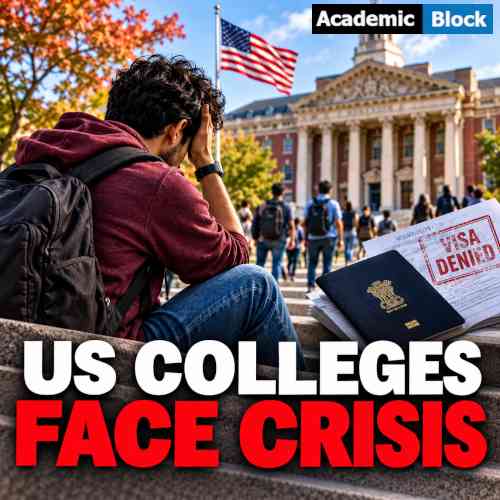
US Colleges Face Growing Crisis as International Student Enrollment Declines
American colleges are bracing for another difficult year as fewer international students are showing up at college campuses this fall. The international enrollment at American campuses has dropped 9% this fall compared with last year. The number of first-time arrivals fell even further by 15%. Graduate programs took the hardest hit, losing 15% of their international students, while undergraduate numbers felt a decline too. The largest source of foreign students, India is also sending fewer students each year. Fall 2026 figures from individual campuses suggest the downturn has not eased.
The fallout reaches well beyond the admissions office. International students have always played a major role in funding US economy since international students pay more and spend heavily in local economies. However, their contribution to the US economy shrank by $2.4 billion this fall. Many of them pay full tuition, which sometimes helps colleges fund financial aid and services for domestic students. College leaders estimate that each international student in a public bachelor’s program opens two seats for Americans. That makes this decline a concern for domestic families too.
A $70,000 OPT Fee Proposal and Visa Bottlenecks Are Pushing Students to Look Elsewhere
Several pressures have converged to make the United States a harder sell for overseas applicants. The Institute of International Education has pointed to fewer applications, visa appointment delays, and new immigration restrictions. Concerns about the political climate have also played a role. A single proposal from he DHS has rattled college leaders more than most. Homeland Security wants schools to pay $70,000 for every student in Optional Practical Training. The rule is not final, yet OPT participation has already fallen 6% this fall. The program matters because it covers roughly a quarter of international students. It also often leads to long-term work visas, such as the H-1B.
Visa headaches are making things worse. Of more than 800 colleges surveyed, 88% blamed the application process, and 70% cited travel restrictions. For now, a federal court has blocked a July rule capping study at four years without approval. The financial stakes are high because international students pay more and spend heavily in local economies. Meanwhile, schools in Europe and Asia are reporting gains, which suggests students are weighing other options. However, the administration says tougher vetting is meant to stop visa fraud and protect American jobs.
American Campuses Feel the Financial Strain Due to Steep Decline
Some schools can already put a dollar figure on the damage. Cleveland State University has watched international enrollment fall 46% in two years, from approx. 1,542 to 828 students. Fewer than 50 new international students started there this fall. The estimated the hit to the budget is at $2 million to $4 million. For a university of that size, the gap is hard to absorb. Bigger School names are feeling it too. Ohio State’s international enrollment fell nearly 13%, its lowest level in 16 years. The University of Washington’s Seattle campus has now seen two straight yearly declines, reaching a decade-low. Illinois Institute of Technology plans to borrow up to $200 million from its endowment to cope. Denison University, where international students make up 17% of the student body, also expects steep declines.
Ultimately, the decline in international enrollment is no longer a distant warning for American higher education, as the fall in international enrollment has moved from a warning sign to a real strain on college budgets. Its effects reach financial aid, graduate research, even the seats available to American students and local economies across the country. Rival study destinations are competing hard for the same talent, so a steady recovery may not come easily. Colleges that rely on foreign tuition will need to adjust quickly if applications keep falling. How Washington handles visas and work programs will likely decide whether the United States stays a top choice for students worldwide or not.
Web Resources on
1. AP News : Fewer students are traveling from abroad to study at US universities, report shows.
2. Politico : US colleges struggle as international students turn away.
3. Academic Block : International Students Could Face $70,000 Work Permit Fee Under Trump Plan.