
US Launches Second Night of Strikes on Iran as Hormuz Tensions Deepen
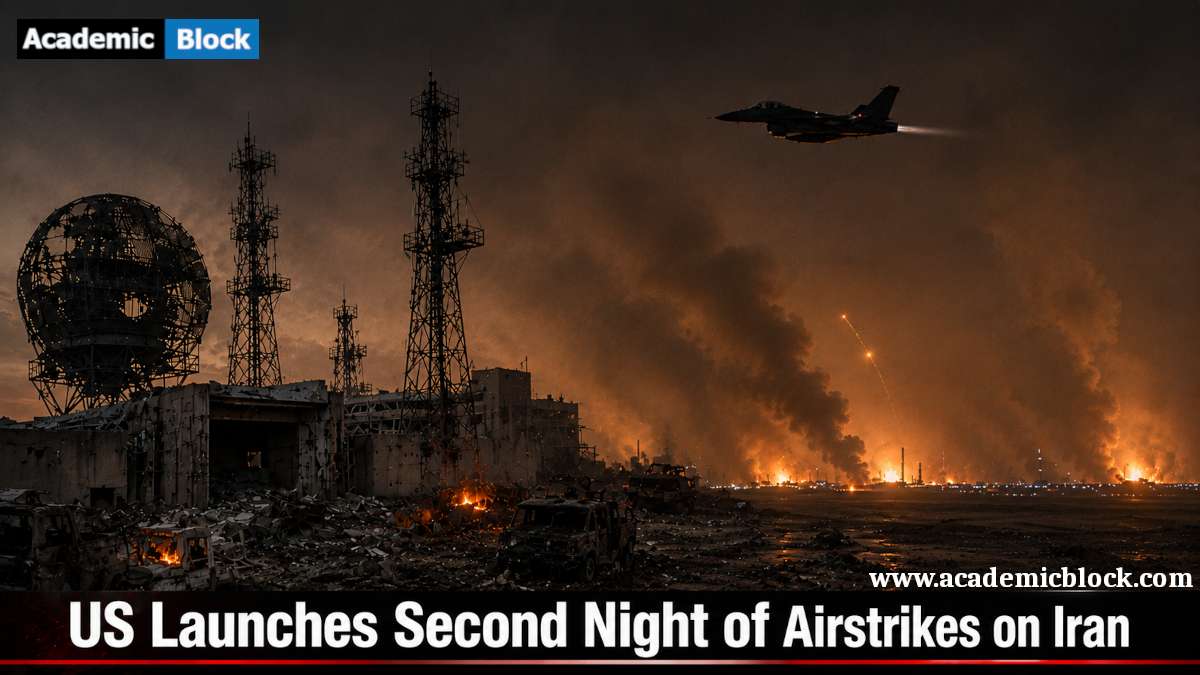
The United States launched a second consecutive night of military strikes on Iran as tensions around the Strait of Hormuz intensified. U.S. Central Command (CENTCOM) said the operation followed an Iranian attack on a commercial vessel in the strategic waterway. According to the U.S. military, President Donald Trump directed the strikes to hold Iranian forces accountable and deter further attacks on international shipping.
Washington said the latest military action marked a response to growing threats against commercial shipping in one of the world’s busiest maritime routes. However, Iran rejected the U.S. account and said it was defending its territorial rights. Tehran also carried out fresh military action across the Gulf region. The competing claims have increased uncertainty around the Strait of Hormuz and placed new pressure on diplomatic efforts to prevent a wider regional conflict.
US Targets Iranian Military Infrastructure Across Strategic Locations
CENTCOM said the latest operation focused on degrading Iran’s military capabilities linked to maritime operations. American forces targeted air defense systems, radar sites, missile positions, drone facilities, coastal surveillance locations, and small boats operated by Iran’s Islamic Revolutionary Guard Corps. Fighter jets, naval vessels, and drones participated in the coordinated strikes. The U.S. military also repeated that the Strait of Hormuz remains open and said it is prepared to protect commercial shipping through the vital waterway.
The strikes extended into several areas across southern and central Iran. Iranian officials reported attacks near Ahvaz and Andimeshk in Khuzestan Province. State media also reported casualties at a water pumping station in Mahshahr and the death of a navy officer near the port of Jask. Explosions were reported in Qeshm Island, Bandar Abbas, and Hajiabad. Iranian reports did not attribute every incident to a specific attacker and referred only to unspecified “enemy” fire. The latest operation has expanded the geographic scope of the conflict and heightened regional security concerns.If the US-Iran confrontation continues to escalate, it could disrupt regional security, global energy supplies, international trade, and commercial shipping through the Strait of Hormuz.
Iran’s Response Raises Regional Risks and Market Uncertainty
Iran’s Islamic Revolutionary Guard Corps (IRGC) said it launched drone and missile attacks against several U.S. allies following the American strikes. Kuwait reported damage to border posts and an offshore oil rig, while Qatar said it intercepted drones and confirmed three injuries. Jordan reported missiles landing inside its territory without casualties. The United Arab Emirates said it detected incoming threats before they entered its airspace, and Bahrain urged residents to remain in shelters for a second straight day. These developments highlighted how the confrontation has spread beyond Iran and the United States.
The military escalation also affected global energy markets and diplomatic efforts. Brent crude climbed nearly 4% to almost $79 a barrel, while U.S. crude rose to around $74 a barrel as traders assessed risks to shipping through the Strait of Hormuz. Meanwhile, the latest exchanges have weakened a fragile interim agreement signed in June by President Donald Trump and Iranian President Masoud Pezeshkian. United Nations Secretary-General António Guterres warned that renewed large-scale fighting could have catastrophic consequences. As both sides continue to exchange military action, the Strait of Hormuz remains at the center of regional stability, global energy security, and future diplomatic efforts.
Web Resources On US Launches Second Night of Strikes on Iran
1. CNN.com : US launches strikes on Iran for a second night.
2. BBC.com : US insists Strait of Hormuz is open as it exchanges strikes with Iran.
3. AP News.com : US and Iran vie for Strait of Hormuz, waterway key to global energy supplies, in latest attacks,