
Australia and India Seal Landmark Uranium Agreement
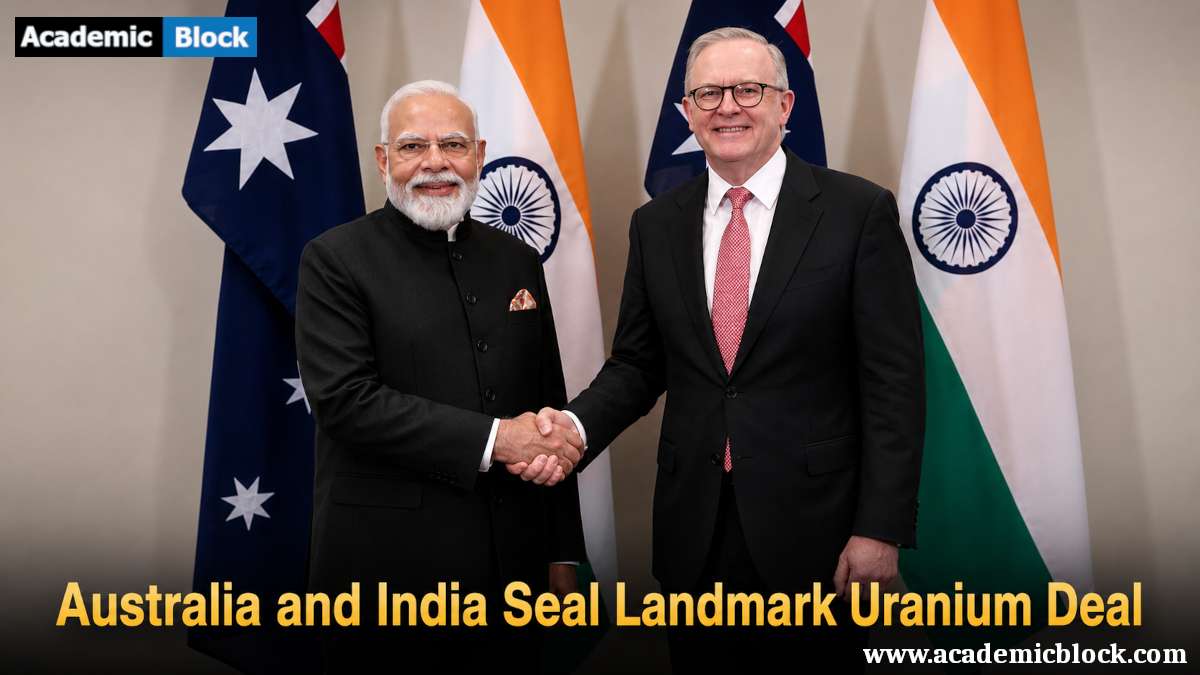
Australia and India have signed a landmark agreement that paves the way for Australian uranium exports to India for peaceful civilian nuclear use. The announcement followed talks between Australian Prime Minister Anthony Albanese and Indian Prime Minister Narendra Modi during the Annual Leaders’ Summit in Melbourne on July 9. The agreement completes the administrative arrangements required to implement the Australia-India Civil Nuclear Cooperation Agreement, bringing an end to years of regulatory delays that had held back commercial uranium trade.
The agreement also delivers significant long-term benefits for both countries. India aims to expand its nuclear power capacity to 100 gigawatts by 2047, making a stable supply of uranium an important part of its clean energy transition and long-term energy security. At the same time, Australia, which holds the world’s largest known uranium resources, gains greater access to one of the world’s fastest-growing energy markets. In addition, the deal supports Australia’s strategy to diversify its export destinations while strengthening economic cooperation with India.
Long-Delayed Nuclear Agreement Finally Moves Into Operation
The Australia-India uranium agreement brings nearly two decades of diplomatic efforts to fruition. After India’s 1998 nuclear tests, the country faced international technology restrictions and limited access to uranium supplies. However, the 2008 Nuclear Suppliers Group (NSG) waiver allowed member countries to begin civilian nuclear trade with India. Australia subsequently signed the Australia-India Civil Nuclear Cooperation Agreement in 2014, which entered into force in 2015, although commercial exports remained on hold pending administrative approvals.
The latest administrative arrangement has now removed those final barriers, allowing Australian uranium exports to begin under the bilateral agreement. All uranium supplies will be used exclusively for India’s civilian nuclear energy programme and will remain under strict International Atomic Energy Agency (IAEA) safeguards.
India and Australia Expand a Broader Strategic Partnership Beyond Uranium
The uranium agreement represents only one part of the rapidly expanding India-Australia relationship. During the leaders’ summit, Prime Minister Narendra Modi and Australian Prime Minister Anthony Albanese agreed to strengthen cooperation across renewable energy, green hydrogen, critical minerals, resilient supply chains, and advanced technologies.
The two leaders also reaffirmed their commitment to expand trade and investment through the Economic Cooperation and Trade Agreement (ECTA) while continuing negotiations on a Comprehensive Economic Cooperation Agreement (CECA). Furthermore, they pledged closer cooperation in defence, maritime security, and a free, open, and rules-based Indo-Pacific. Modi invited Australian businesses to invest in India’s infrastructure, including roads, ports, railways, and urban development. Meanwhile, Albanese described India as a trusted partner and highlighted the value of deeper economic engagement.Together, the initiatives strengthen India-Australia cooperation in energy security, economic resilience, and the Indo-Pacific.
Web Resources on Australia and India Seal Uranium Agreement
1. Reuters.com : Australia, India strike deal on uranium exports during Modi visit.
2. AP News.com : Australia agrees to sell uranium to India, ending a long stalemate.
3. The Economic Times : India, Australia unlock uranium trade, step up energy and supply chain cooperation.