
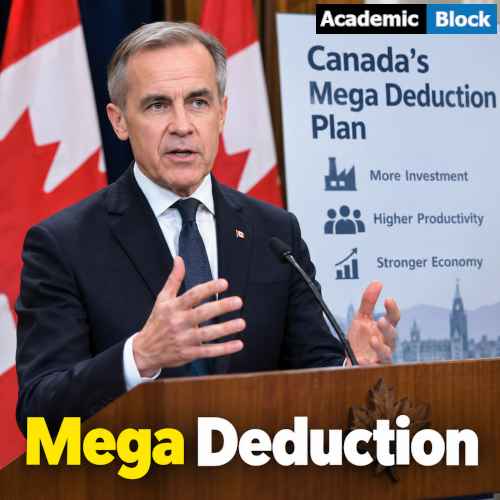
Canada’s Big Tax Bet: Canadian PM Carney Unveils “Mega Deduction” to Power the Economy
In the recent rapidly changing economic and international landscape, Canada plans to power its economy through the introduction of “Mega Deduction” during the first Canada Investment Summit 2026 aiming to build a more independent and resilient economic foundation. Through this summit Canada aimed to secure and attract investments into major projects and industries that would create more job opportunities in the near future in Canada while boosting various Canadian development and growth sectors, boosting their eonomy. The intent is to reduce the after-tax cost of building things in Canada and give companies a stronger incentive to invest and to encourage businesses to expand productive capacity, invest in technological adavancements and modernize or replace outdated machinery and equipment.

Canada is introducing a major change to its business tax system as Prime Minister Mark Carney’s government moves to lower investment costs and attract more private capital into the country through “Productivity Mega Deduction” on Sept. 15 at the first Canada Investment Summit in Toronto. The permanent tax measure would allow businesses to immediately to claim a faster tax deduction on a wider range of investments allowing the investors or companies to reduce their taxable income sooner after putting new equipment or other qualifying assets into use. The move is part of Ottawa’s broader goal to attract more than C$1 trillion in investment, particularly in mining, energy, technology and infrastructure, as Canadian government seeks to strengthen its economy with global investments into their country amid trade tensions with the United States.
Quote from PM during the Canada Investment Summit 2026:
“Canada has what the world wants. We’re an energy superpower, with the most educated workforce in the world and rock-solid fiscal strength. The first-ever Canada Investment Summit will capitalize on those advantages to help drive billions in new investments into Canada. That means more growth for our businesses, more high-paying career opportunities, and a stronger, more independent Canadian economy for all.”
– The Rt. Hon. Mark Carney, Prime Minister of Canada
The concept of “Mega Deduction” In easier terms, it refers to the policy designed to make a new investment less expensive after taxes. Potentially improving the ROI (Return On Investment) for companies considering whether to invest in Canada or not. Generally, businesses that purchase expensive equipment or other capital assets cannot deduct the entire cost from their taxable income immediately. Instead, the cost is typically deducted over several years through capital cost allowance. Immediate write-offs change that calculation. A qualifying business can deduct the full cost of an investment in the year the asset becomes available for use. This does not mean that the government directly pays for the equipment. Instead, the company may pay less tax sooner, improving its cash flow and lowering the effective cost of the investment.
Canada GDP Rebounds 3.3% in Q2 2026
Canada’s economy recovered strongly between April to June 2026, with real GDP rising 0.8% in the second quarter When calculated at an annual rate, this equals growth of 3.3%, the fastest pace in more than three years after a near-flat first quarter (January to March), that was later revised up to a 0.1% gain. The expansion was driven by higher exports, increased household spending and stronger business investment and continued growth in the service-producing industries, which account for about 72% of Canada’s economic output, led the growth. However, manufacturing dropped 1.4% in June, while the monthly GDP advanced 0.3% in June for a third steady climb.
Real GDP per capita rose 1.0% in Q2 (second quarter of the year i.e., April to June) 2026, aided by a slight population decline, and Canada remained the world’s 10th-largest economy, with its 2025 nominal GDP estimated at approximately US$2.32 trillion and its annual real economic growth in 2025 was roughly estimated at about 1.7%. Through the First Canada Investment Summit 2026, the government aims to attract global and heavy private captial investment into the country to boost their economy.
Canada Broadens Immediate Expensing Under New Mega Deduction
On September 15, 2026, Under PM Mark Carney’s announced major tax change called the Productivity Mega Deduction, Canadian businesses can immediately deduct the full cost of most new equipment, machinery and infrastructure in the year they start using it, instead of spreading the deduction over many years. This expands the old “super deduction”, which covered only about 15% of capital assets to roughly 65% of business investments, and the government says it will stay in place permanently so companies can plan with confidence.
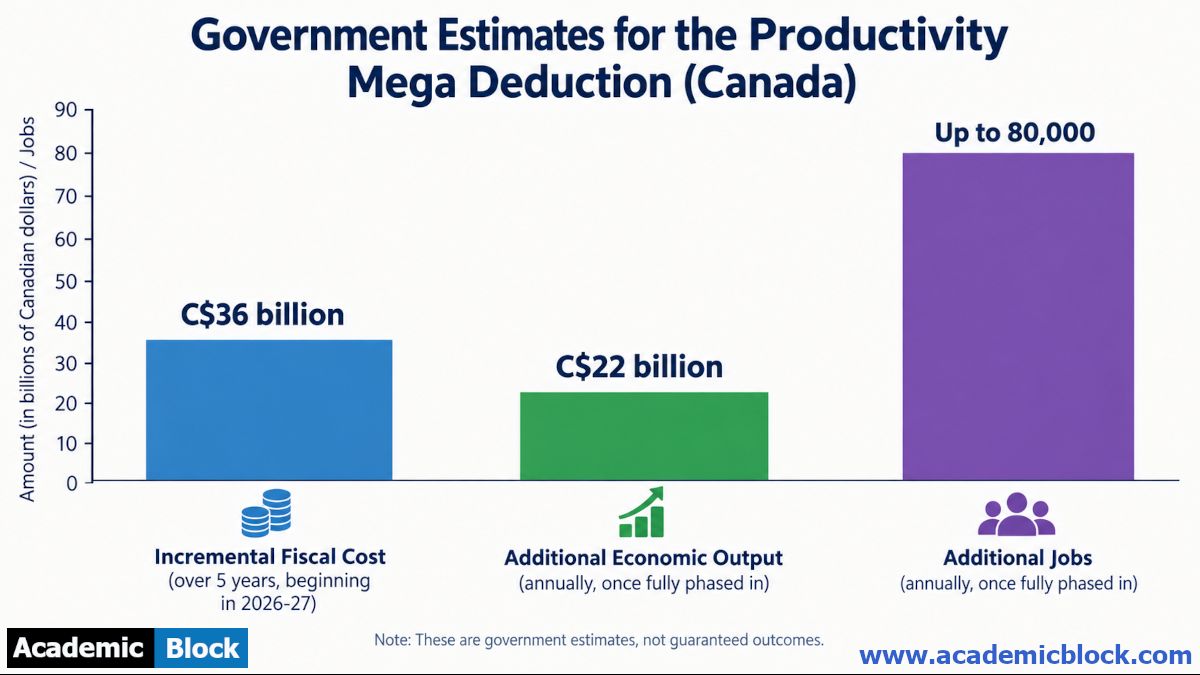
The deduction covers items like fibre-optic internet cables, mining equipment, oil and gas pipelines, software, computers, aircraft, rail equipment, bridges and roads. However, the deduction does not cover every type of investment. Most buildings, some intangible assets such as franchises and goodwill, certain natural gas pipelines, some types of vehicles (unless newly assembled in Canada), and certain natural resource rights are excluded. The Department of Finance estimates that the tax change will cost about C$36 billion over five years, but at the same time this policy will reduce the effective tax rate on new business investment from around 13% to 6.4%, making Canada one of the most tax-competitive countries in the G7 for new capital spending.
Mega Deduction Canada: Support Meets Skepticism
The Ontario Chamber of Commerce has welcomed the Productivity Mega Deduction, saying permanent immediate deductions and broader eligibility could lower the cost of investing in equipment, technology and other productivity-enhancing assets. The chamber also called for a simpler and more better-coordinated tax system. While the business organizations have generally welcomed the tax changes, arguing that faster write-offs could improve the economics of major Canadian projects and make the country more financially attractive and help the country compete for global investment, the policy has also drawn criticism over the potential public cost of tax incentives and questions about which industries will ultimately benefit.
The government is also seeking private, long-term investment in the operations of Canada’s four largest airports : Toronto, Montreal, Vancouver and Calgary ; while retaining public ownership of land and assets. This new tax policy has reportedly gained interest from infrastructure investors, while labour groups have raised concerns about the potential impact on travellers and airport workers. The broader investment strategy has faced opposition as it was met with hundreds of protesters gathered in Toronto during the summit, with labour groups, environmental activist groups, migrant-rights and social-justice groups criticizing some elements of this new plan, including fossil-fuel projects and private investment in public assets.
Canada’s Tax Break Now Faces the Investment Test
The central question is whether the Canada business investment tax break will lead companies to invest more capital in the Canadian infratructure and economy. Immediate write-offs can lower the after-tax cost of qualifying investments, but it does not guarantee that businesses will build new facilities, expand production, establish operations or invest in Canada. Their government is betting on this permanent tax relief, faster investment decisions and a broader investment strategy to strengthen the Canadian economy and productive capacity. The government’s projections and estimates are substantial and ambitious, but the actual effect of the Productivity Mega Deduction 2026 will ultimately depend on how businesses assess and respond to this “Mega Deduction”and how much economic growth production, employment and new inevstment follows in the longer run.
Web resources on Canada’s Mega Deduction
1. Canada.ca : Government of Canada introduces new Productivity Mega Deduction to boost Canada’s advantage.
2. Statcan.gc.ca : Gross domestic product, income and expenditure, second quarter 2026.
3. PM.gc.ca : PM Carney introduces new Productivity Mega Deduction to boost Canada’s advantage as the most competitive G7 country for new business investment.
4. Reuters : Canada offers permanent tax incentive on capital investment as Carney lures investors.
5. OCC.ca : Ontario Chamber Welcomes Productivity Mega Deduction as a Major Step to Unlock Investment.
6. Reuters : Hundreds march in Toronto against Carney’s investment summit.