
Elon Musk Says a $3.5 Trillion SpaceX-Tesla Merger Is “a Good Idea”
Elon Musk is eyeing a historic merger between his two powerhouse companies, SpaceX and Tesla. On Tuesday, he told investors during SpaceX’s quarterly earnings call that combining the two companies would be “a good idea.” Both firms have formed special committees to study a potential merger. Together, they are valued at roughly $3.5 trillion, making a deal potentially the largest corporate merger ever. Following the announcement, SpaceX shares jumped about 8% in extended trading, while Tesla shares rose nearly 2%. However, Musk stressed that no terms have been agreed upon and that a merger remains uncertain.
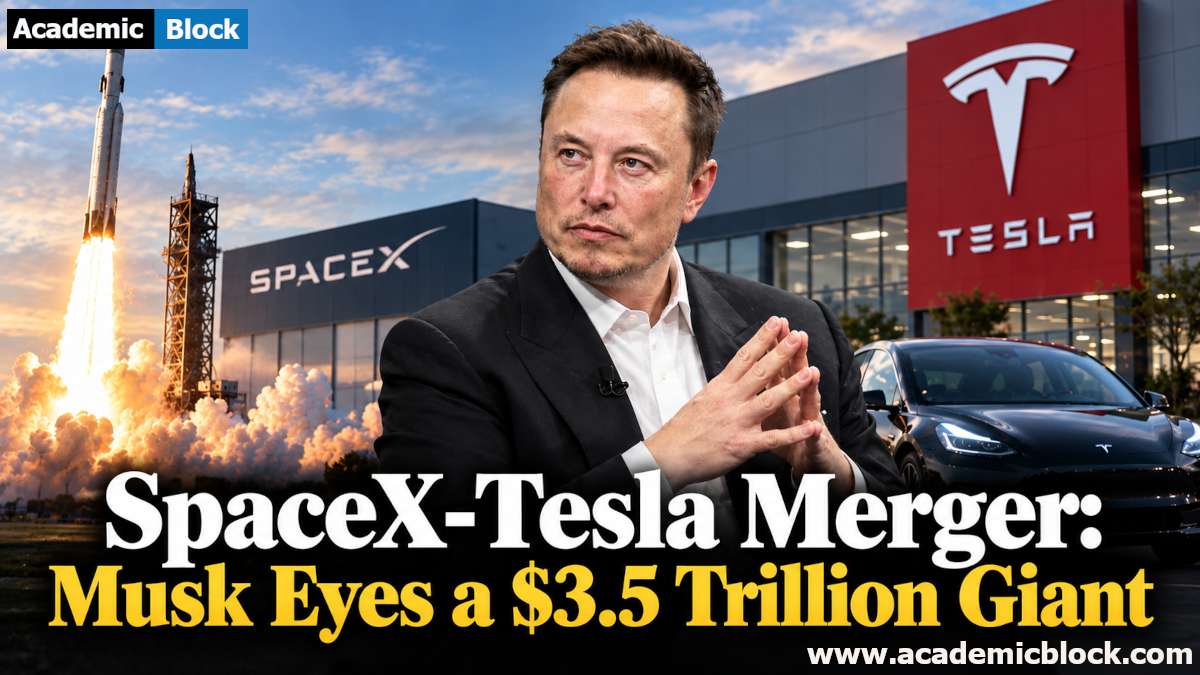
Musk cannot join the talks, because he runs both firms and is a conflicted party. Instead, independent directors sit on the committees, which were formed at shareholders’ request. He admitted that even discussing the subject felt risky. He also pointed to shared work on robotics and the Terafab chip venture between the two companies (SpaceX and Tesla), which aims to manufacture advanced chips for next-generation technologies. Even if the two companies combine. Tesla is already prioritizing the Model Y and Model 3, and now makes Optimus robots in California. Thus, Tesla shareholders would gain exposure to Starlink, launch services and future space ventures. SpaceX investors would, in turn, own Tesla’s vehicle, energy storage, autonomous driving and robotics units.
SpaceX Profits Soar as AI Boom Fuels Musk’s Merger Plans
Musk’s merger proposal comes as SpaceX reports strong financial growth. Revenue for the three months ended September 30 surged 161% to $14.58 billion, well above analysts’ expectations of $12.7 billion. Net income reached $4.4 billion, reversing a loss of about $1.1 billion a year earlier. Artificial intelligence drove much of the turnaround. SpaceX now calls its AI division Super Intelligence, and its revenue rose more than ninefold to $7.56 billion. Much of that income comes from renting data-center capacity to companies such as Anthropic and Google. As a result, the business operates more like a cloud-computing provider than a traditional chatbot developer.
Starlink also continued to expand, with connectivity revenue rising 69% to $5.25 billion and consumer subscribers reaching 13.6 million. However, average monthly revenue per subscriber fell from $99 in 2023 to $69, largely because of cheaper plans in international markets. Meanwhile, spending has climbed sharply. Capital expenditure nearly tripled to $19.6 billion, including $16.4 billion for AI. SpaceX expects capital expenditure to reach $35 billion to $40 billion in the fourth quarter. Musk argues that SpaceX and Tesla already share interests in chips, robotics and space-based computing. Their joint chipmaking venture, Terafab, is expected to produce its first test chip around May or June next year.
Geopolitical Tensions and Regulatory Risks Cloud Musk’s SpaceX-Tesla Merger Plan
The biggest hurdles may be geopolitical and regulatory, not financial. SpaceX is a major contractor for the US military, intelligence agencies and NASA. Tesla, meanwhile, leans heavily on China through its Shanghai factory, which plays a major role in production and sales. Combining the two could therefore draw closer scrutiny from US regulators and national-security officials. Beijing may also take a keen interest, since one company would hold both defense ties and Chinese operations. The biggest test, however, is the Tesla shareholder vote. Musk said approval would need half of all Tesla shares, not just those cast. He called that bar quite a high hurdle.
A stronger Democratic result in next month’s US midterms might bring tougher regulatory scrutiny, since many Democrats have criticized Musk. Critics warn that combining the businesses could increase investors’ exposure to technical, regulatory and execution risks. Ultimately, Musk’s endorsement turns long-running speculation into a formal process with real stakes for investors and regulators. The outcome now rests with independent directors, who must agree on terms, and with Tesla shareholders, who must then vote. Governments in Washington and Beijing may also weigh in, given SpaceX’s defense work and Tesla’s China exposure. If it succeeds, a single company would span cars, rockets, satellites, robots and AI computing under one leader. That would reshape how investors value Musk’s empire and how closely governments watch it.
Web Resources on SpaceX and Tesla merger talks
1. BBC : Elon Musk confirms he is considering merging Tesla and SpaceX.
2. Reuters : Musk says SpaceX-Tesla merger is ‘a good idea’ as companies form deal committees.
3. Japan Times : Musk seizes on SpaceX momentum with push toward Tesla merger.
4. BBC : Why is Elon Musk plotting a mega-merger of SpaceX and Tesla?
5. Reuters : Why would Musk merge SpaceX and Tesla?